How has GMT vs Bitcoin performance changed over the past year? While most cryptocurrency investors focus on a token’s USD price, I believe measuring GMT against Bitcoin provides a much more interesting perspective.
Bitcoin is the underlying asset that powers the GoMining ecosystem. If GMT is increasing in value relative to BTC, it suggests that GMT holders are gaining purchasing power against the very asset that GoMining helps users mine.
I decided to investigate this by looking at the GMT/BTC exchange rate over the past year, starting on 6 November 2025 and ending on 6 November 2026.
The results are interesting.
Using a 30-day moving average to smooth out daily price fluctuations, GMT appreciated approximately 24.96% against Bitcoin over the past year.
But there is something else worth considering.
During this same period, the utility and economic activity of the GoMining ecosystem have also increased. More users have joined, more hashrate has been purchased, Marketplace activity has grown, and more GMT has been locked.
Could these developments be contributing to GMT’s performance?
And perhaps an even more interesting question: Could someone have participated in the growth of GoMining simply by buying GMT, without ever purchasing a miner?
Let’s examine the data and the broader economic picture.
1. Why the GMT vs Bitcoin Comparison Matters
Most cryptocurrency investors measure performance in USD.
For example, if GMT increases from $0.30 to $0.40, we would normally describe that as a 33.3% appreciation.
But what if Bitcoin increases by 50% over the same period?
In that scenario, GMT has actually underperformed Bitcoin, despite increasing in USD value.
This is why I believe the GMT vs Bitcoin comparison provides a more interesting perspective.
There are two different questions:
- Is GMT appreciating in USD terms?
- Is GMT appreciating relative to Bitcoin?
The second question is particularly relevant to GoMining because Bitcoin mining is at the heart of its ecosystem.
If GMT appreciates against BTC, its relative market value is increasing rather than simply following Bitcoin’s movements.
For someone participating in a Bitcoin mining ecosystem, this is an important distinction.
I have previously explored the relationship between mining economics and GMT utility in my article Build Your Farm First. The underlying idea is that mining power and GMT serve different but complementary purposes within the GoMining ecosystem.
2. GMT vs Bitcoin: How I Measured the One-Year Performance
For this analysis, I used historical GoMining token price data from CoinMarketCap.
The observation period is:
- Starting date: 6 November 2025
- Ending date: 6 November 2026
- Duration: One year
Rather than looking exclusively at the daily exchange rate, I calculated a 30-day moving average.
Why?
Cryptocurrency prices are volatile. A single day’s movement can distort the overall picture, especially when examining a relatively smaller token such as GMT.
A 30-day moving average helps reduce short-term noise and makes it easier to identify the underlying trend.
I also indexed the exchange rate to 100 at the beginning of the observation period.
This allows us to measure the relative performance of GMT against BTC without being distracted by the absolute exchange rate.
The calculation is straightforward:
GMT/BTC Performance = (Current GMT/BTC Exchange Rate ÷ Starting GMT/BTC Exchange Rate) × 100
A reading above 100 means GMT has appreciated against Bitcoin.
A reading below 100 means GMT has depreciated against Bitcoin.
For reference, the historical price data can be explored through CoinMarketCap’s GoMining historical data.
3. GMT vs Bitcoin: The Results Are Quite Interesting
The 30-day moving average started at approximately 0.0000037771 BTC per GMT on 6 November 2025.
By 6 November 2026, it had increased to approximately 0.0000047198 BTC per GMT.
That represents an appreciation of 24.96%.
The spot exchange rate tells an even stronger story.
| Metric | 6 Nov 2025 | 6 Nov 2026 |
|---|---|---|
| GMT/BTC spot | 0.0000037381 | 0.0000050529 |
| GMT/BTC 30-day average | 0.0000037771 | 0.0000047198 |
| Indexed moving average | 100 | 124.96 |
There are two important figures to highlight:
- 30-day moving average: +24.96%
- Spot exchange rate: +35.17%
For this article, I will use the 24.96% figure as the primary measure because it is less affected by daily volatility.
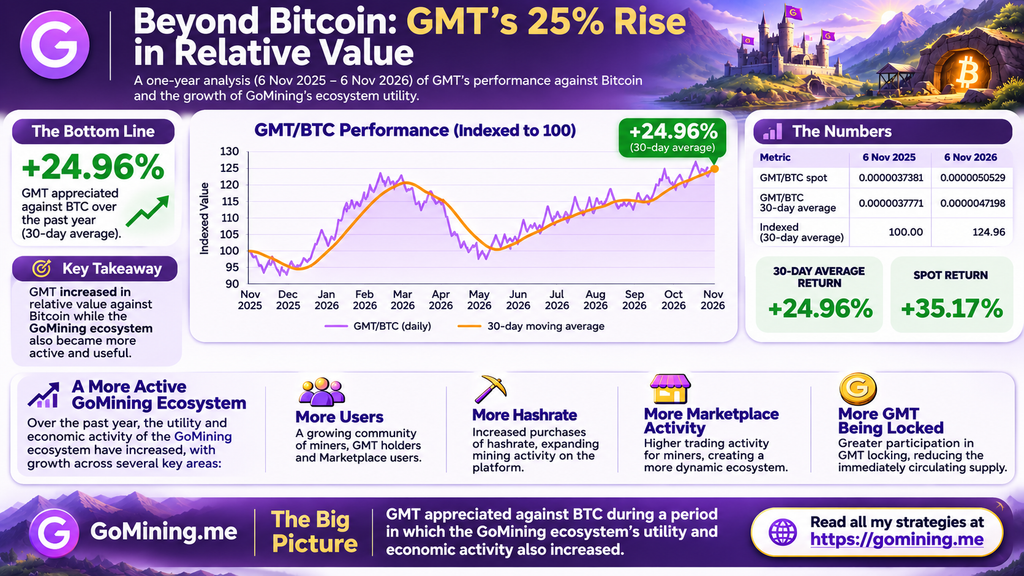
The conclusion is quite clear: GMT has appreciated against Bitcoin over this one-year period.
This is an encouraging result for GMT holders.
4. GMT vs Bitcoin: What Happened During the Year?
The overall appreciation is interesting, but the journey is equally important.
Looking at the smoothed chart, there are several distinct phases.
Phase 1: November to December 2025 – Initial Weakness
GMT initially depreciated against Bitcoin.
The 30-day moving average declined from its starting level of 100 to approximately 93.
This means GMT temporarily lost around 7% of its relative value against BTC.
It is a useful reminder that holding GMT does not guarantee continuous appreciation.
Phase 2: January to March 2026 – Strong Recovery
GMT experienced a strong recovery during the first quarter of 2026.
The 30-day moving average climbed above 120, representing an appreciation of approximately 20% from the starting benchmark.
This was the first major indication that GMT was outperforming Bitcoin.
Phase 3: April to May 2026 – Giving Back Some Gains
The recovery did not continue uninterrupted.
GMT weakened against BTC, with the moving average returning close to 100 in May.
At this point, most of the earlier relative appreciation had disappeared.
Someone looking only at the short-term price movement might have concluded that GMT had lost its momentum.
However, the subsequent recovery would tell a different story.
Phase 4: June to November 2026 – Sustained Recovery
From June onwards, the 30-day moving average recovered and gradually established a higher trading range.
By September and October, GMT was consistently trading above its original indexed value.
The period ended with the moving average at approximately 125.
This suggests that GMT’s appreciation was not simply a single-day price spike.
There was a broader recovery in its relative value against Bitcoin.
5. Beyond Price: GoMining’s Growing Ecosystem Utility
I think this is where the analysis becomes particularly interesting.
Over the past year, GMT has not only appreciated against Bitcoin. The utility and economic activity of the GoMining ecosystem have also increased.
A token’s long-term value proposition should not be evaluated solely by looking at its price chart.
We should also examine whether the underlying ecosystem supporting that token is becoming more useful and economically active.
I see four important developments.
A. More Users Joining GoMining
As GoMining attracts more users, the potential demand for its ecosystem services and token utilities increases.
More participants mean a larger community of miners, GMT holders and Marketplace users.
A growing user base can contribute to greater demand for the different services and utilities available within the ecosystem.
This creates a broader foundation for economic activity.
B. More Hashrate Being Purchased
Hashrate is at the core of GoMining’s business model.
When users purchase additional mining power, they are expanding their participation in the Bitcoin mining ecosystem.
More hashrate purchased means greater mining capacity being deployed through the platform.
This is important because it demonstrates growth in the underlying activity that gives GoMining its economic purpose.
It also creates a larger ecosystem of miners who may participate in upgrades, maintenance discounts, VIP progression and other GMT-related utilities.
C. Increased Marketplace Activity
The GoMining Marketplace is another important component.
As more users participate in buying and selling miners, Marketplace activity increases.
This creates more opportunities for transactions within the ecosystem and potentially increases demand for GMT-related utilities.
A more active Marketplace also makes the ecosystem more dynamic, connecting existing users with new participants.
The Marketplace is therefore not just a place to trade miners. It is another component of the wider economic activity taking place within GoMining.
D. More GMT Being Locked
Finally, the increase in GMT locking is particularly interesting.
Locking GMT is an important part of the GoMining tokenomics model.
Users lock their tokens to participate in the ecosystem’s locking mechanisms and obtain associated benefits.
As more GMT gets locked, the amount of tokens immediately available for circulation is reduced.
This is an important supply-side consideration.
However, we should distinguish between tokens being locked and tokens being permanently removed from supply. Locked tokens may eventually become available again, depending on their locking periods.
Nevertheless, increasing GMT locking demonstrates greater participation in the locking mechanism and can reduce the immediately available circulating supply while those tokens remain locked.
For a deeper look at this mechanism, see the official GoMining documentation on veGOMINING and token locking.
6. Could You Participate in GoMining Without Mining?
This brings me to another interesting question.
Could someone have participated in the growth of the GoMining ecosystem simply by buying GMT, without purchasing any miners or owning any hashrate?
I believe this is an important question because it highlights the distinction between participating in Bitcoin mining and participating in the GoMining token economy.
GoMining offers different ways to participate in its ecosystem.
A miner owner participates directly in Bitcoin mining. They purchase hashrate, receive mining rewards and manage their mining economics through electricity costs, maintenance fees and potential miner upgrades.
However, GMT holders have a different route.
By acquiring GMT, users can participate in the token economy through mechanisms such as locking, VIP progression and associated ecosystem benefits.
They do not necessarily need to own mining power to hold GMT or participate in its locking mechanisms.
The official GoMining GOMINING token documentation explains that the token supports several ecosystem functions, including maintenance payments, miner purchases, locking, governance and rewards.
Consider someone who purchased 10,000 GMT one year ago and simply held those tokens.
Based on the 30-day average GMT/BTC exchange rates:
At the beginning:
10,000 × 0.0000037771 = 0.037771 BTC
At the end:
10,000 × 0.0000047198 = 0.047198 BTC
The difference is approximately 0.009427 BTC.
That represents approximately 24.96% appreciation against Bitcoin.
The interesting part is that this person did not need to purchase additional hashrate, manage electricity costs or upgrade any miners to benefit from GMT’s relative price appreciation.
Of course, there are important distinctions.
A GMT-only holder does not automatically receive Bitcoin mining rewards. They also do not directly benefit from mining income, hashrate growth or miner-specific economics.
Their exposure is primarily to GMT’s market performance and its utility within the GoMining ecosystem.
Furthermore, simply holding GMT is different from locking it. Additional ecosystem benefits associated with locking depend on the amount locked, duration and applicable conditions.
For example, the GoMining VIP programme recognises both mining power and veGOMINING votes when determining VIP progression.
Nevertheless, I find this particularly interesting.
It suggests that GoMining has more than one potential participation pathway.
You can participate through:
- Mining: Purchase hashrate and participate directly in Bitcoin mining.
- GMT ownership: Acquire GMT and gain exposure to its market performance and ecosystem utility.
- Mining + GMT: Combine mining economics with GMT ownership and locking benefits.
In other words, you do not necessarily need to mine Bitcoin to have exposure to GoMining’s ecosystem growth.
For someone who does not want to manage mining operations, acquiring and locking GMT could offer an alternative way to participate in the ecosystem.
This is an important distinction because it broadens the GoMining proposition beyond mining alone.
7. How Does Ecosystem Growth Relate to GMT vs Bitcoin Performance?
Let’s bring these observations together.
Over the same one-year period, we have seen:
| Ecosystem development | Potential economic implication |
|---|---|
| More users | Greater potential demand for ecosystem services and utilities |
| More hashrate purchased | Expansion of mining activity and miner-related economic activity |
| More Marketplace activity | Greater transaction activity within the ecosystem |
| More GMT locked | Reduced immediately available circulating supply |
These developments are important because they point towards something broader than a simple increase in token price.
We are seeing growth across several dimensions of the GoMining ecosystem.
I believe these are all potential contributing factors to GMT’s performance.
However, an important qualification is necessary.
At this stage, it is not possible to isolate the individual contribution of each factor to GMT’s 24.96% appreciation against Bitcoin.
We cannot conclusively say how much of the appreciation came from increased user adoption, additional hashrate purchases, Marketplace activity or GMT locking.
These factors interact with one another, and the token’s market price is also influenced by broader cryptocurrency market conditions, liquidity and investor sentiment.
Therefore, I would not claim that ecosystem growth alone caused GMT to outperform Bitcoin.
Instead, I would make a more measured observation:
GMT appreciated against Bitcoin during a period in which the utility and economic activity of the GoMining ecosystem also increased.
That combination is worth paying attention to.
It suggests that we should evaluate GMT not just as a tradable cryptocurrency, but also as a token whose value proposition is connected to the growth and economic activity of its underlying ecosystem.
I have explored the supply-side dimension of this relationship in my earlier analysis, GMT Tokenomics: 272 Million GMT Locked.
The amount of GMT locked, the mechanics of the Burn & Mint system and the demand generated by ecosystem utility are all important pieces of the bigger picture.
8. Does This Mean GMT Will Continue Appreciating Against Bitcoin?
Not necessarily.
One year of historical performance is encouraging, but it is not enough to establish a long-term trend.
There are several factors worth monitoring.
Token Supply and Locking
The amount of GMT entering circulation, the amount being locked and the amount being permanently burned can influence the supply-demand dynamics of the token.
In particular, the relationship between new GMT issuance, permanent burns and locking activity deserves continued attention.
GoMining Ecosystem Growth
The demand for GMT depends partly on the usefulness of the token within the ecosystem.
Miner upgrades, VIP benefits, discounts, Marketplace activity and other utilities all contribute to this equation.
The more useful GMT becomes, the stronger its underlying utility proposition could become.
Bitcoin Market Performance
GMT vs Bitcoin is a relative valuation.
Even if GMT remains stable in USD, it can depreciate against BTC if Bitcoin appreciates faster.
This is why I believe monitoring the GMT/BTC ratio is just as important as monitoring GMT/USD.
For anyone interested in how Bitcoin mining works and why its economics matter, the Bitcoin.org mining FAQ provides a useful introduction.
Market Sentiment and Liquidity
GMT remains exposed to cryptocurrency market volatility.
Its relative performance can change significantly depending on market conditions, liquidity and investor sentiment.
These factors mean that the 24.96% appreciation should be viewed as a historical observation, not a forecast.
9. My Takeaway: Look at Both GMT’s Price and Its Utility
I find this analysis encouraging.
For a long time, cryptocurrency investors have been conditioned to measure everything in USD.
But if you participate in a Bitcoin mining ecosystem, perhaps the more interesting benchmark is Bitcoin itself.
Over the period from 6 November 2025 to 6 November 2026, GoMining GMT appreciated approximately 24.96% against BTC based on its 30-day moving average.
That is a meaningful result.
But what makes this observation even more interesting is the broader ecosystem development taking place alongside it.
More users, more hashrate purchased, increased Marketplace activity and more GMT being locked all point towards an ecosystem that is becoming more economically active.
We also need to recognise that participation in GoMining does not necessarily require owning mining power. Someone holding GMT can participate in the token economy and gain exposure to its relative price performance, even without operating a miner.
We cannot attribute GMT’s appreciation to any single one of these factors. Nevertheless, looking at price performance together with ecosystem utility gives us a more complete picture of the token’s development.
I would like to see whether GMT can maintain or improve its relative performance over the next two to three years.
For now, I believe there is a good reason to keep monitoring the GMT/BTC ratio alongside the usual GMT/USD price chart.
Leave a Reply