GoMining Farm profitability isn’t just about how much TH you own. It’s about how cheaply you can keep mining when Bitcoin prices fall and other miners are struggling to survive.
My GoMining Farm will never be unprofitable.
Never? Yes, you heard that right. Never.
What gives me the confidence to make such a bold statement? How can I be so confident that my farm will continue mining through the harshest Bitcoin winter, even when BTC prices collapse and mining economics become increasingly difficult?
The answer isn’t that I believe Bitcoin will always go up. Neither is it because I expect mining rewards to remain high.
It comes down to something much more fundamental: my operating costs relative to everyone else’s.
I don’t need to be the biggest miner. I don’t even need to own the most technologically advanced hardware in the world.
I need to be among the most cost-efficient miners in the market.
And I believe my GoMining farm is positioned to do exactly that.
Let’s look at why.
1. GoMining Farm Profitability Starts With Staying Ahead of the Curve
The first principle of surviving a Bitcoin mining winter is simple: keep your operating costs as low as possible.
I have two important advantages.
Energy Efficiency: 12 W/TH
My miners are running at 12 W/TH, which is the optimum Energy Efficiency level available within GoMining’s current miner range.
Of course, there are more efficient physical mining machines in the wider market. Some of the latest-generation ASICs, including hydro-cooled machines, are already pushing towards 9 W/TH.
But I don’t need to own the absolute best hardware in the world.
I need to maintain a competitive position within the mining ecosystem.
Lower W/TH means less electricity consumed for every TH of computing power. This directly reduces my operating costs and improves my net mining rewards.
GoMining explains this relationship in its Energy Efficiency documentation.
Discounts: My Second Competitive Advantage
The second advantage is my 27% combined maintenance discount.
This is particularly important because I don’t just want efficient miners. I want efficient miners operating at the lowest possible cost.
Let’s put some numbers to this.
My operating assumptions are:
- Electricity: $0.05/kWh
- Energy Efficiency: 12 W/TH
- Maintenance: $0.0089 per TH per day
- Combined discount: 27%
My daily electricity cost per TH is:
12 × 0.05 × 24 ÷ 1,000 = $0.0144
Adding maintenance:
$0.0144 + $0.0089 = $0.0233
After applying my 27% discount:
$0.0233 × (1 − 0.27) = $0.01701 per TH per day
That’s approximately $6.21 per TH per year.
This is my operating cost advantage.
And here’s the important distinction: it isn’t simply about having low fees. It’s about having lower operating costs than the miners competing against me.
I want to be on the right side of the profitability curve.
This is the foundation of my GoMining Farm profitability strategy. I am not simply trying to maximise mining rewards. I am trying to minimise the cost of generating every TH of mining power.
For more details on how GoMining calculates maintenance costs and applies discounts, see its Maintenance Fees and Discounts guide.
2. When Bitcoin Falls, Inefficient Miners Exit the Market
This is where my strategy becomes particularly interesting.
Bitcoin mining is a competitive business. Every miner competes for a share of the available block rewards, but not everyone has the same operating costs.
When Bitcoin prices rise, even inefficient miners can remain profitable.
But when Bitcoin prices fall, the economics change dramatically.
Imagine Bitcoin falling from $100,000 to $60,000.
The USD value of mining revenue falls, but electricity and maintenance costs don’t automatically fall with it.
Who gets hurt first?
- Miners operating at 20 W/TH.
- Miners operating at 15 W/TH.
- Miners with inefficient hardware and poor energy economics.
- Miners paying higher operating fees because they have inadequate discounts.
Some will begin operating at a loss. Others will decide that continuing to mine simply doesn’t make economic sense.
Eventually, some of them will switch off their machines and exit the market.
And this is precisely where my competitive advantage begins to matter.
I don’t need every miner to remain profitable.
I need the less efficient miners to become unprofitable before I do.
3. GoMining Farm Profitability Benefits When Bitcoin Difficulty Falls
What happens when a significant number of miners leave the Bitcoin network?
Network hashrate decreases.
Bitcoin’s difficulty adjustment mechanism eventually responds.
Bitcoin adjusts mining difficulty every 2,016 blocks, approximately every two weeks, to maintain an average block time of around 10 minutes.
When miners leave and blocks take longer to produce, difficulty adjusts downwards.
You can read more about this mechanism in the Bitcoin Developer Guide.
And when difficulty decreases, the remaining miners benefit.
Why?
Because each TH of mining power now represents a larger share of the network’s total mining power.
The Bitcoin protocol continues distributing block rewards according to the same underlying rules. However, with less competing hashrate, each remaining TH has a greater probability of earning those rewards.
In practical terms, the same mining equipment can generate more BTC per TH after a downward difficulty adjustment.
This is an extremely important part of my investment thesis.
When inefficient miners exit, the remaining miners can capture a larger share of the available Bitcoin rewards.
Of course, this doesn’t mean that Bitcoin’s USD price automatically recovers. A sufficiently large BTC price decline can still outweigh the benefit of lower difficulty.
But the reduction in difficulty helps improve the mining economics of those who remain.
And I want to be among those who remain.
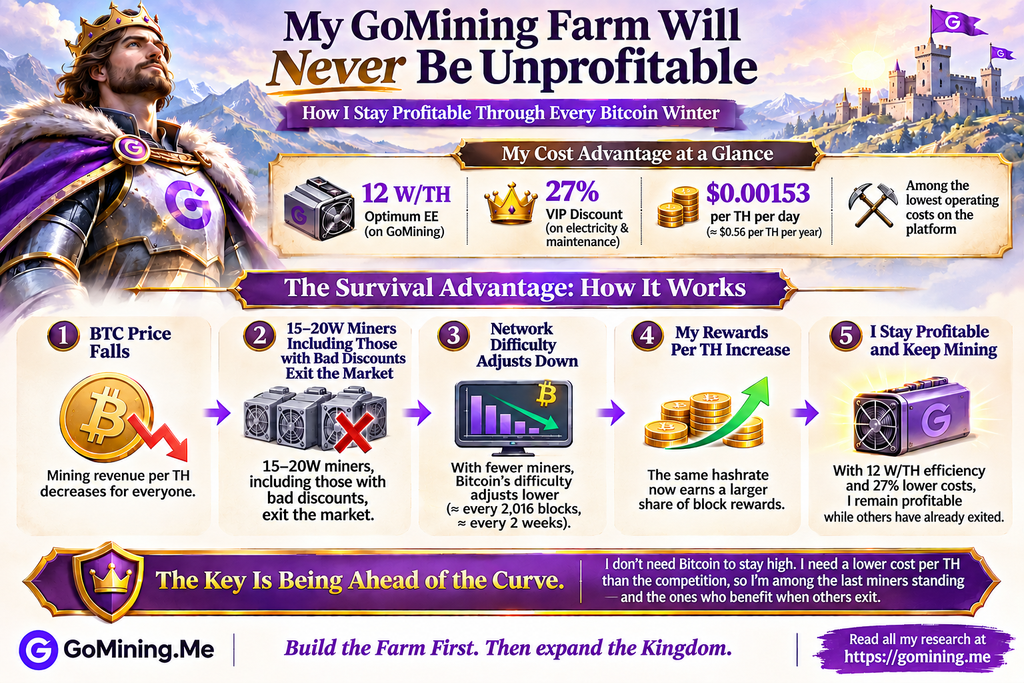
4. It’s Not Just About Profit Margin. It’s About Survival.
There is a difference between having a profitable mining farm today and having a mining farm that can survive the next Bitcoin winter.
I am much more interested in the latter.
Think about the cycle:
- Bitcoin prices fall.
- Mining revenue per TH decreases.
- 15–20 W/TH miners, including those with bad discounts, start losing money and exit the market.
- Network hashrate falls.
- Bitcoin difficulty eventually adjusts downwards.
- Remaining miners receive a larger share of block rewards per TH.
The miners who survive the downturn are in a better position to benefit from the adjustment.
This is why I place so much importance on Energy Efficiency and discounts.
Some people prefer to maximise their TH immediately. They believe that more mining power is always better.
But I look at it differently.
TH determines how much mining power I contribute.
EE determines how much electricity I need to operate that mining power.
Discounts reduce my operating costs even further.
These three factors work together.
A farm with substantial TH but poor EE and inadequate discounts might look impressive during a bull market. But when Bitcoin enters a prolonged downturn, that same farm could become a liability.
I would rather have a farm that can withstand the downturn than one that looks impressive only when Bitcoin is going up.
This is also why I previously wrote about Energy Efficiency as a Risk-Control Strategy. Efficiency isn’t simply about increasing today’s rewards. It’s about protecting the economics of the farm over the long term.
5. My GoMining Farm Is Built to Outlast the Competition
My entire GoMining Farm profitability strategy revolves around one principle: I want to be among the last miners standing when the next Bitcoin winter arrives.
I am not claiming that Bitcoin prices cannot collapse further. I am not claiming that difficulty will always decrease, or that my mining revenue will always exceed operating costs under every conceivable circumstance.
There are risks.
Difficulty can continue increasing. Bitcoin prices can fall faster than difficulty adjusts. GoMining’s fee structure and discount arrangements can change.
But my strategy is built around a fundamental principle.
I want to be ahead of the profitability curve, not chasing it.
When Bitcoin is rising, my farm benefits from the higher BTC price.
When Bitcoin is falling, my lower operating costs give me a better chance of remaining profitable while less efficient miners struggle.
And when enough of those miners leave, the resulting difficulty adjustment can improve the economics for the miners who remain.
That is the competitive advantage I am building.
I don’t need every miner to survive.
I don’t need Bitcoin to remain at $100,000.
I need to maintain a cost advantage over the competition.
Because in Bitcoin mining, sometimes the greatest opportunity isn’t being the biggest miner.
It’s being the miner who is still standing when everyone else has switched off.
My GoMining farm isn’t built just for the bull market. It’s built to survive the bear market.
And that’s why I believe my GoMining farm will never be unprofitable.
Build the Farm First. Then expand the Kingdom.
Leave a Reply