GMT tokenomics are becoming increasingly interesting as more tokens are locked and the supply available for trading potentially shrinks. As of 22 October 2026, 272.7 million GMT tokens are locked, representing approximately 67.7% of the reported supply of 402.68 million tokens. Nearly 20 million additional GMT have been locked over the past 60 days, while the average locking duration stands at 2 years and 10 months.
At a reported market price of $0.3766, GMT’s evolving supply dynamics raise an important question: what happens as more tokens enter long-term locking contracts?
As the locked supply grows, the effective APR earned by participants could decline, with current projections suggesting approximately 15% APR at 350 million GMT locked.
But here’s the important point: a lower APR does not automatically mean GMT is becoming a less attractive investment. To understand why, we need to look beyond locking rewards and examine the relationship between token scarcity, potential price appreciation, and the future utility of GMT.
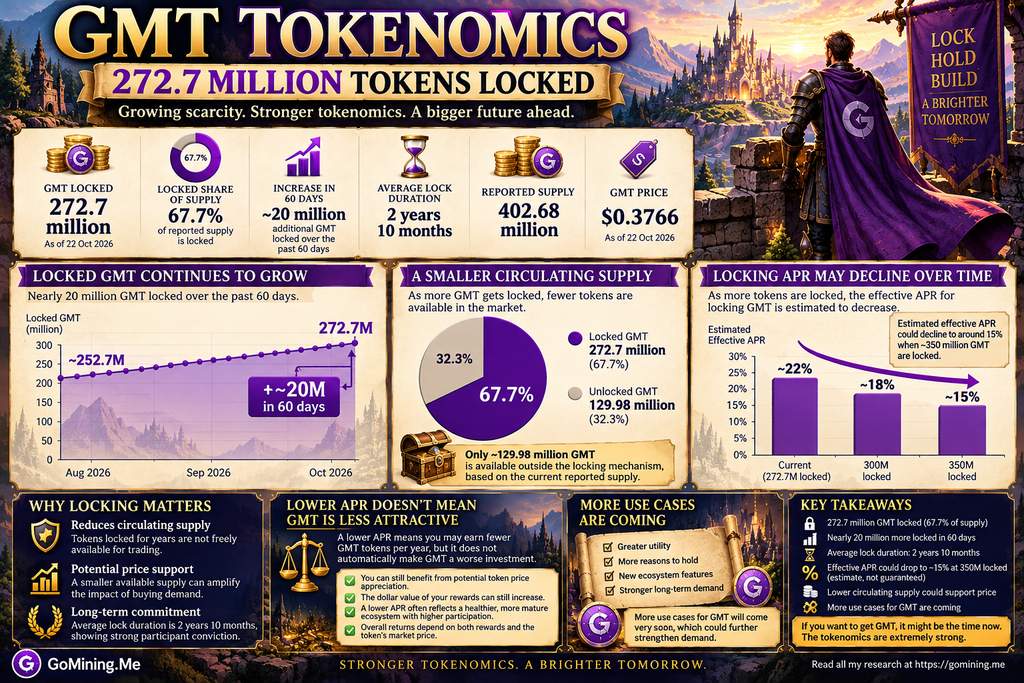
GMT Tokenomics: 272.7 Million Tokens Are Now Locked
The latest figures tell an interesting story.
- GMT locked: 272.7 million
- Reported token supply: 402.68 million
- Locked share of reported supply: Approximately 67.7%
- GMT locked over the past 60 days: Nearly 20 million additional tokens
- Average locking duration: 2 years and 10 months
- GMT price: $0.3766 as of 22 October 2026
Based on these figures, approximately 129.98 million GMT are outside the reported locked supply.
That is a substantial difference between the total reported supply and the amount currently locked.
The recent increase is equally noteworthy. Nearly 20 million GMT have been locked in just two months, suggesting that participants continue to commit tokens to the locking mechanism.
Of course, locked tokens are not permanently removed from existence. Their availability depends on the applicable locking terms and unlock schedules. Nevertheless, tokens committed for extended periods are not as readily available for ordinary trading.
That distinction matters when evaluating GMT’s supply dynamics.
How Does GMT Locking Affect Circulating Supply?
When more GMT is locked, fewer tokens may be available for immediate trading, assuming other supply flows remain unchanged.
This creates a potential supply-side tailwind.
Imagine a market where demand for GMT remains stable or increases while the amount of readily available supply declines. Buyers would be competing for a smaller pool of tokens, potentially increasing upward pressure on the market price.
To understand how GMT locking fits into the wider ecosystem, readers can review the official GoMining documentation on maintenance fees and discounts, which explains how GMT-related benefits can affect mining economics.
However, scarcity alone does not guarantee appreciation. Demand, market sentiment, liquidity, token unlocks, and broader cryptocurrency conditions still matter.
The strongest bullish scenario would combine a growing number of locked tokens with sustained or increasing demand for GMT.
That is the relationship worth watching.
How GMT Tokenomics Affect Circulating Supply
There is another side to the equation.
As more GMT is locked, the effective APR earned by participants may decline if the reward pool does not grow proportionally with the locked supply.
Based on the current projection, the effective APR could move towards approximately 15% when the total locked supply reaches 350 million GMT.
That would require another 77.3 million GMT to be locked from the current level of 272.7 million.
The projected decline in APR is not necessarily a sign that the tokenomics are deteriorating. It may simply reflect a changing relationship between the available rewards and the amount of GMT participating in the locking mechanism.
The 15% figure should be treated as an estimate, not a guaranteed return. Actual APR will depend on the reward mechanism and any changes to its parameters.
And this brings us to a crucial distinction.
A Lower APR Doesn’t Mean GMT Is Less Attractive
Investors often focus heavily on APR because it is easy to compare. A 22% APR looks better than a 15% APR at first glance.
But APR tells only part of the story. Understanding GMT tokenomics means looking beyond the headline APR. A lower reward rate does not necessarily indicate weaker token economics. Investors should also consider token utility, the value of rewards, and whether the locking mechanism continues to provide meaningful benefits.
Your total return depends on both the rewards you earn and what those rewards are worth.
Consider three potential outcomes:
- You earn fewer GMT tokens, but the market price of GMT increases.
- You earn fewer GMT tokens, and the market price remains unchanged.
- You earn fewer GMT tokens, and the market price declines.
These scenarios produce very different results, even if the APR is identical.
A lower APR can still be attractive if the overall investment economics remain favourable. Conversely, a high APR can be disappointing if the token price falls enough to offset the rewards.
For example, imagine an investor holds 10,000 GMT.
At a hypothetical 22% annual reward rate, the investor would earn 2,200 GMT over a year, assuming a constant rate and simple rewards.
At 15%, the investor would earn 1,500 GMT under the same assumptions.
The difference is 700 GMT. But the dollar value of the resulting holdings would also depend on GMT’s market price.
This example is illustrative only; actual rewards may differ depending on the locking mechanism, compounding, and changes in APR.
The lesson is simple: do not evaluate GMT solely by the number of tokens earned. Evaluate the potential total return and the risks involved.
Could a Lower APR Reflect a More Mature Ecosystem?
A declining APR can also be consistent with a growing locking base.
If more participants commit GMT to a reward mechanism whose pool grows more slowly than the locked supply, the reward rate per token may fall.
That does not automatically make the mechanism worse. It means investors need to assess whether the remaining rewards, token utility, and potential market value justify locking their capital.
There is a balance to consider:
- Higher APR can make locking more attractive, but it does not guarantee a profitable investment.
- Lower APR may reduce the incentive to lock, but it does not automatically undermine GMT’s other sources of value.
- Greater token utility could support demand even if locking rewards decline.
- A smaller readily available supply could amplify the effect of buying demand, provided that demand actually exists.
In other words, APR is one component of GMT’s tokenomics, not the entire investment thesis.
GMT Tokenomics and the Potential for Price Appreciation
At $0.3766, GMT’s potential price trajectory will depend on how supply and demand evolve.
If locking continues to absorb tokens from the readily tradable supply, while ecosystem activity and demand strengthen, the conditions could become more favourable for price appreciation.
The key factors to monitor are:
- The growth of total locked GMT.
- The amount of GMT that remains available for trading.
- The effective APR and how it changes over time.
- Demand generated by existing and new ecosystem use cases.
- The broader cryptocurrency market and its effect on risk appetite.
A sustained increase in locked supply could support a bullish thesis. But investors should not assume that lower available supply automatically translates into a higher price.
The supply side matters. Demand matters just as much.
More GMT Use Cases Could Strengthen the Investment Thesis
Beyond locking and rewards, future utility may become an important driver of GMT demand.
More use cases could give participants additional reasons to acquire, hold, spend, or lock the token. If those use cases generate genuine incremental demand, they could strengthen the economic foundation of GMT.
This is an important development to watch as GoMining evolves.
However, future use cases should be treated as potential catalysts until their details, implementation, and actual impact on demand are clear.
A strong tokenomics thesis needs more than scarcity. It needs reasons for people to want the token.
Is Now the Time to Consider GMT?
With 272.7 million GMT locked and nearly 20 million added over the past 60 days, the current supply dynamics are worth monitoring.
The projected 350 million milestone is particularly interesting because it could coincide with a lower effective APR. Investors should consider that possibility rather than assuming today’s rewards will remain unchanged indefinitely.
For those who believe in GoMining’s long-term prospects, the decision should come down to a few questions:
- Do you understand how GMT locking rewards work?
- Are the potential rewards attractive even if APR declines?
- Do you believe future ecosystem utility can generate sustainable demand?
- Can you tolerate price volatility and the reduced liquidity associated with locking?
- Does the investment fit your financial situation and risk tolerance?
These questions are more useful than simply chasing the highest advertised APR.
Final Thoughts: Look Beyond APR
GMT tokenomics are evolving. As of 22 October 2026, 272.7 million tokens are locked, approximately 67.7% of the reported supply. Nearly 20 million additional tokens have been locked over the past 60 days.
The next milestone to watch is 350 million locked GMT, where the current projection estimates an effective APR of around 15%.
But a declining APR does not necessarily mean GMT is becoming less attractive. The value of locking rewards depends on the number of tokens earned, their market value, and the broader economics of the ecosystem.
If the available supply continues to tighten while genuine demand and token utility grow, GMT could benefit. If demand weakens, scarcity alone may not be enough.
Don’t look at APR in isolation. Look at the whole picture: supply, rewards, utility, demand, and risk.
This is why I believe in one principle: Build the Farm First. Strong GoMining economics are not just about chasing the highest APR or accumulating as much hashrate as possible. They are about building a sustainable farm, managing operating costs, and using GMT strategically to strengthen your financial resilience over time.
That is how to evaluate GMT’s long-term potential.
Disclaimer: This article is for educational and informational purposes only and does not constitute financial advice. Cryptocurrency investments carry significant risks, including price volatility, liquidity constraints, and changes to tokenomics. The figures and APR projections discussed are based on the stated assumptions and are not guarantees of future performance.
Leave a Reply