Bitcoin mining profitability can take a hit even when the price of BTC barely moves. Network difficulty just increased by 5.92%, and suddenly, your mining profits are under pressure. Your miners are still running. Your hashrate hasn’t changed. But you’re earning a smaller share of the network’s rewards.
So, what’s the solution? Buy more TH?
Not so fast.
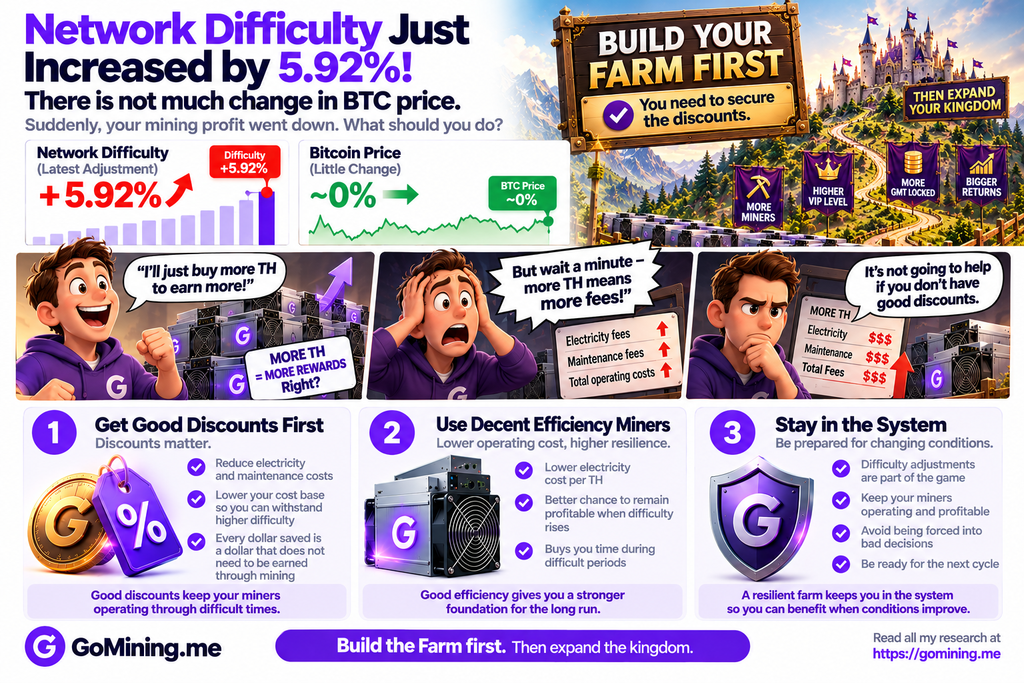
Bitcoin Mining Profitability: Why Rising Difficulty Hurts
Bitcoin mining is a competitive business. When network difficulty increases, each unit of hashrate generally earns fewer BTC, assuming block rewards, transaction fees and other conditions remain comparable.
The problem is that your operating costs don’t automatically fall with difficulty.
Your miner still consumes electricity. Maintenance fees still need to be paid. And if you’re running a miner with poor energy efficiency, your margins can get squeezed even faster.
A nearly unchanged BTC price doesn’t protect you from this.
This is why Bitcoin mining profitability isn’t just about how much BTC you earn. It’s also about how much it costs to earn it.
“I’ll Just Buy More TH to Earn More!”
We’ve all seen the temptation.
Difficulty goes up. Mining rewards per TH come under pressure. The obvious reaction is to buy more hashrate and try to make up the difference.
But wait a minute.
More TH means more fees.
More hashrate can generate more rewards, but it also brings additional operating costs. If your new TH comes with high maintenance costs and you haven’t secured good discounts, you’re scaling up both sides of the equation.
You might earn more BTC in total and still fail to improve your net profitability.
That’s the difference between growing a mining farm and building a profitable mining farm.
Before you commit more capital, read my article on why $/TH is the wrong way to compare GoMining Miners. The purchase price is only one part of the equation. You also need to consider efficiency, operating costs and the capital required to keep the miner running.
Build the Farm First: Good Discounts Matter
This is where I think many miners get their priorities wrong.
They focus on buying more TH before building the economic foundation that supports it.
Build the Farm first. Then expand the kingdom.
Before adding more miners, make sure you have a strategy for reducing your recurring costs.
In GoMining, maintenance discounts can make a meaningful difference to your net mining rewards. The less you spend on maintenance, the more of your mined BTC you get to keep.
For an explanation of how the discount system works, see GoMining’s official guide, The Latest Changes to GoMining’s Maintenance Discount Program.
The important point is not simply to chase the highest advertised discount. Consider what it costs to obtain and maintain that discount, and calculate the actual savings against your farm’s operating expenses.
A discount that improves your economics is valuable. A discount that costs you more than it saves is not.
Discounts matter because they lower the revenue your farm needs to cover its costs.
Bitcoin Mining Profitability Depends on Energy Efficiency
Discounts are the first priority. Energy efficiency is the other part of the foundation.
A miner with better energy efficiency consumes less electricity per unit of hashrate. That means it generally has lower electricity costs for the same amount of mining power.
When difficulty rises and revenue per TH falls, that difference becomes more important.
A less efficient miner might look acceptable when mining conditions are favourable. But when margins tighten, its higher operating costs can become a serious burden.
If you’re comparing miners or considering an upgrade, read my research on The Economics of Energy Efficiency.
The goal isn’t necessarily to own the newest or most efficient miner available. It’s to find a combination of purchase price, energy efficiency and maintenance costs that makes economic sense.
Good efficiency gives your farm more breathing room. Good discounts reduce your costs further.
Together, they make it easier to withstand difficult mining conditions.
Stay in the System, But Don’t Expand Blindly
Difficulty adjustments are part of Bitcoin mining. They will continue to happen, and you cannot control when they occur.
You also cannot control the price of BTC.
What you can control is how prepared your farm is.
Make sure your miners have decent efficiency. Secure discounts that genuinely improve your returns. Monitor your net rewards after maintenance, rather than focusing only on the gross BTC you mine.
And before buying more TH, ask yourself a simple question:
Will this purchase improve my net economics, or will it simply increase my operating expenses?
If your farm already has a strong cost base, adding hashrate may make sense. If your existing miners are struggling to cover costs, expanding without addressing the underlying problem could make things worse.
The objective isn’t to keep buying TH at any cost. It’s to build a farm that can keep operating through different market conditions.
The Bottom Line: Build the Farm First
Network difficulty just increased by almost 6%. BTC barely moved, but mining profitability came under pressure.
That’s exactly why your strategy needs to account for more than just hashrate.
- Get good discounts first. Reduce recurring costs and improve your margin.
- Use decent-efficiency miners. Don’t let electricity consume your rewards.
- Expand when the economics make sense. More TH is useful only when the additional rewards justify the additional costs.
You can’t control difficulty. You can’t control BTC price. But you can prepare your farm to handle both.
Don’t rush to build a bigger kingdom on a weak foundation.
Build the Farm first. Then expand the kingdom.
And remember: when difficulty rises, more TH isn’t automatically the answer.
Sometimes, the best move is to make the TH you already own work harder for you.
Leave a Reply