MinerWars GMT demand is something I have become increasingly interested in after spending just one day playing MinerWars. I have always been a believer in GMT, but this short experience has made my conviction in its long-term potential even stronger.
Interestingly, it wasn’t because I won anything. In fact, I decided to leave after just 24 hours and return to solo mining.
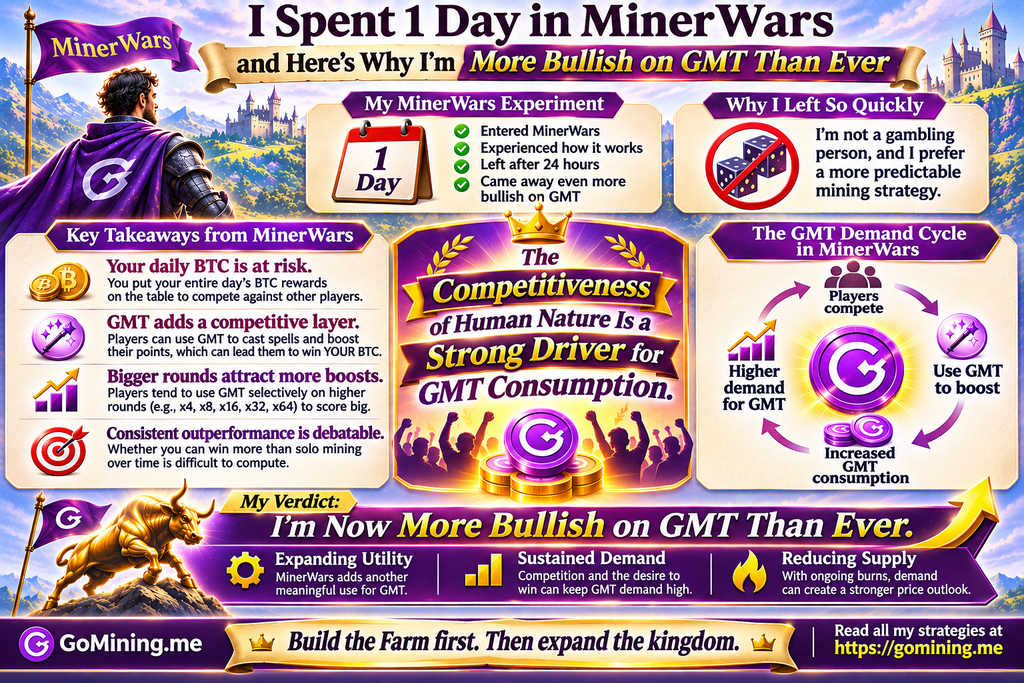
But that one day taught me something important about MinerWars GMT demand: the competitiveness of human nature could become one of the strongest drivers of GMT consumption.
And I think this is something worth paying attention to.
Why I Decided to Try MinerWars
Recently, I heard another GoMining user share his experience after spending 52 weeks in MinerWars. According to him, he had achieved approximately 30% more BTC rewards than his solo mining rate.
That caught my attention.
An additional 30% above the solo mining rate is certainly attractive. Naturally, I became curious about whether MinerWars could offer a meaningful improvement to my own mining returns.
I decided to give it a try, initially intending to participate for a few months before making my own verdict.
My stay, however, was unbelievably short.
Just one day.
And I was out.
What I Learned From My One Day in MinerWars
After experiencing MinerWars firsthand, I realised that there are several important things to understand about how the game works.
1. Your Daily BTC Mining Rewards Are Now Part of a Competition
When you enter MinerWars, your miners switch from Mining Mode to Game Mode.
Instead of receiving your regular daily BTC mining rewards in the usual way, you participate in clan battles where BTC rewards are distributed according to the competition’s results.
Essentially, you are competing with other clans for BTC rewards.
You are hoping that your clan wins enough rounds to earn more BTC than you would have received from mining solo.
Of course, this is not guaranteed.
Your clan could win several rounds, or it could win very few. Your eventual BTC rewards depend on the competition’s results.
This changes the nature of your mining experience considerably.
For the official mechanics, see GoMining’s Miner Wars documentation.
2. GMT Introduces Another Layer of Competition
This is where things get interesting.
Players can spend GMT to activate spells and boosts, increasing their points and improving their chances of winning individual rounds.
In other words, you are not just competing against other players’ mining power. You are also competing against their willingness to spend GMT.
Someone who initially has a lower probability of winning can use boosts to improve their position.
And this can change the outcome of a round.
I began to realise that MinerWars introduces a completely different dynamic compared with solo mining.
You can read more about the mechanics in GoMining’s Spells and Power-ups guide.
3. Can You Consistently Earn More Than Your Solo Mining Rate?
This is the million-dollar question.
Over an extended period, are you statistically expected to earn more BTC than you would have earned through solo mining?
I think this is debatable.
The mathematics are considerably more complicated than they initially appear.
You need to account for clan probabilities, individual player boosts, different block multipliers, personal block draws and the behaviour of other participants.
Without modelling all these variables over a sufficiently long period, it is difficult to establish whether MinerWars consistently produces better returns than solo mining.
The 30% additional BTC reported by the other user is certainly interesting, but one person’s experience is not necessarily representative of everyone’s long-term results.
4. Players Will Likely Use GMT More Aggressively on Bigger Rounds
One thing I started thinking about was how players would behave when bigger block multipliers appeared.
Consider rounds with x4, x8, x16, x32 and x64 multipliers.
These rounds offer the opportunity to capture significantly larger rewards.
Would players be more inclined to spend GMT on boosts when the potential rewards are much higher?
I think so.
The bigger the potential reward, the greater the temptation to spend GMT to improve your chances.
This creates an interesting competitive environment where players may selectively deploy their GMT rather than spending it evenly across every round.
5. Having the Highest Initial Probability Doesn’t Guarantee a Win
This was another interesting observation.
Imagine my clan has an initial 15% probability of winning, while other clans have probabilities of 9%, 7%, 4% and so on.
You would naturally expect my clan to win approximately 15% of the time if those probabilities remained unchanged.
But they don’t necessarily remain unchanged.
Once other players start using GMT to boost their points, the relative probabilities can change.
My clan might have started with the highest probability, but after accounting for the boosts, its actual chance of winning could be considerably lower.
This is an important distinction.
The probability you see before boosts is not necessarily the probability you end up competing with.
6. Sometimes, Your Hope Is That Boosted Players Lose
There is another interesting possibility.
When players from other clans spend GMT to boost their scores but their clans ultimately fail to win, there may be opportunities for personal block winners to capture GMT prizes.
This is another layer of competition.
You are not simply hoping your clan wins. You are also competing individually for personal rewards.
The game has several moving parts, and that makes the outcome difficult to predict.
Why I Left MinerWars After Just One Day
Let me be honest.
I am not a gambling person, and I never will be one.
I understand that MinerWars is a competitive game with defined mechanics, scoring systems and probabilities. It is not simply a matter of luck.
However, the experience made me realise something about myself.
I prefer more predictable economic mechanisms over putting my daily mining rewards into a competitive environment where other players’ decisions can materially affect my outcome.
I would rather mine BTC, understand my operating costs, accumulate GMT and build my mining farm.
So, after just one day, I bolted out of the door and returned to solo mining.
But something unexpected happened.
Although I decided that MinerWars wasn’t for me, I became even more convinced about the importance of GMT.
MinerWars GMT Demand: What the Game Taught Me
This is where my one-day experiment became particularly interesting.
I walked away from MinerWars, but I did not walk away from GMT.
In fact, I came away with three important observations.
1. MinerWars Creates Another Source of Demand for GMT
Before MinerWars, I primarily thought about GMT in terms of its existing utilities:
- Locking GMT to receive weekly rewards.
- Locking GMT to obtain VIP benefits and mining discounts.
- Participating in governance and voting.
- Using GMT for miner-related purchases and upgrades.
Now, there is another important utility: spending GMT to boost your chances of winning in MinerWars.
And I think this is a particularly clever move by GoMining.
Why?
Because MinerWars creates a competitive reason to acquire and spend GMT.
Discounts and locking are primarily driven by economic calculations. Players consider whether the financial benefits justify locking their tokens.
MinerWars introduces a different motivation.
Players are competing against one another. When there is a potentially significant BTC reward at stake, the willingness to spend GMT can increase substantially.
This is a very different demand mechanism.
2. The Competitiveness of Human Nature Is a Powerful Driver of GMT Consumption
This is perhaps my biggest takeaway from MinerWars.
Human beings are naturally competitive.
We want to win. We want to outperform others. We want to have an advantage.
And when there is a reward involved, that competitive instinct can become even stronger.
Consider what happens inside MinerWars:
- Players enter a competitive round.
- Some players decide to spend GMT to boost their points.
- Other players see that their competitors are boosting.
- They may feel compelled to spend GMT themselves to remain competitive.
- More GMT gets spent as players attempt to improve their chances of winning.
This creates a potentially powerful feedback loop.
The interesting part is that players do not necessarily spend GMT because they need a mining discount or want to lock tokens for rewards.
They spend it because they want to win.
That is a completely different psychological driver.
And I believe this is an important distinction when evaluating GMT’s long-term demand.
Economic incentives create demand. Competition can amplify it.
Of course, not every player will spend GMT, and some will choose to participate without buying boosts. But the competitive environment creates a recurring incentive to use the token.
This is what makes MinerWars particularly interesting from a tokenomics perspective.
3. GMT Now Has More Reasons to Be Used Within the Ecosystem
Ultimately, I look at GMT from a tokenomics perspective.
A token becomes more interesting when it has multiple useful applications within its ecosystem.
Consider what we now have:
| GMT utility | Why players use GMT |
|---|---|
| Mining discounts | Reduce operating expenses |
| VIP progression | Unlock additional benefits |
| veGOMINING | Earn rewards and participate in governance |
| Miner upgrades | Improve mining power and efficiency |
| Marketplace | Purchase miners and other digital assets |
| MinerWars | Spend GMT to gain a competitive advantage |
These utilities serve different motivations.
Some players want to reduce their operating expenses. Others want to accumulate rewards through locking. Some want voting power, while others want a competitive advantage in MinerWars.
The important thing is that GMT is not dependent on just one source of demand.
It has multiple reasons for existing within the GoMining ecosystem.
The GMT Demand Cycle: Why MinerWars Could Be Important
I think the relationship between human competitiveness and GMT consumption deserves particular attention.
Unlike locking, where tokens are committed for a period of time, MinerWars introduces a gameplay-driven reason to repeatedly spend GMT.
There is another important detail worth highlighting.
According to GoMining’s official Miner Wars Rewards documentation, 97.5% of the GMT spent on boosts and spells goes into the personal battle prize pool, while the remaining 2.5% goes towards Miner Wars development.
This means that GMT spent on boosts is not simply disappearing from circulation. Most of it is recycled into the reward system and distributed to personal battle winners.
This creates an interesting economic cycle:
Players compete → Players spend GMT on boosts → GMT enters the prize pool → Winners receive GMT → Players have another reason to participate.
The more competitive the environment becomes, the greater the potential for repeated GMT spending.
This is what I find particularly attractive about MinerWars.
It creates a utility that is directly connected to human behaviour.
And human competitiveness is not something that can easily be quantified through a simple discount calculation.
Why I’m More Bullish on GMT Than Ever
Here is my investment thesis.
I believe MinerWars introduces a meaningful additional source of demand for GMT.
But I would not look at MinerWars in isolation.
When we combine it with the existing utilities of GMT, the overall picture becomes much more interesting.
There are three reasons why I remain optimistic.
1. Expanding Utility
GMT is being used across more areas of the GoMining ecosystem.
From mining discounts and miner upgrades to governance, locking rewards and MinerWars boosts, the token has multiple applications.
More utility means more reasons for users to acquire and use GMT.
2. Sustained Demand Driven by Human Competition
This is the part that excites me most.
MinerWars creates a competitive environment where players can repeatedly spend GMT to improve their chances of winning.
The desire to win can be a powerful motivator.
Even players who are not particularly interested in tokenomics may still acquire GMT because they want to compete.
I believe this behavioural element could become an important contributor to sustained GMT demand.
3. A Token Supply Mechanism That Supports Long-Term Scarcity
Demand is only one side of the equation.
The other side is supply.
GoMining has an established Burn & Mint mechanism, where tokens collected through maintenance payments are burned and a smaller amount is minted back according to the tokenomics rules.
The difference between the amount burned and the amount minted determines the net supply reduction.
This is important because increasing utility and demand are more interesting when considered alongside a mechanism that can reduce the token supply over time.
However, there is an important distinction: GMT spent on MinerWars boosts largely enters the prize pool rather than being permanently burned. The supply-reduction argument comes from the separate Burn & Mint mechanism, not from assuming every boost is a permanent burn.
For a deeper explanation, I recommend reading GoMining’s official article on GOMINING Tokenomics: The Mechanics of Burn and Mint Cycles.
I believe the combination of expanding utility, recurring demand and a potentially declining supply creates an interesting long-term economic foundation for GMT.
Of course, none of this guarantees that the market price will rise. Market sentiment, liquidity, token distribution and actual user activity will all matter.
But I believe the fundamentals are becoming increasingly interesting.
My Conclusion: I Left MinerWars, But I’m More Bullish on GMT Than Ever
My MinerWars experiment lasted just one day.
I went in hoping to improve my BTC mining returns. I left because I realised that the competitive nature of the game wasn’t something I wanted to participate in.
But I discovered something much more interesting.
MinerWars gave GMT another reason to be acquired and spent.
And unlike mining discounts or governance, its competitive mechanics introduce a different kind of demand, one driven by the human desire to win.
I might not want to participate in MinerWars, but I certainly appreciate what it could mean for GMT.
My strategy remains unchanged.
I will continue mining BTC solo, accumulating GMT and locking it to strengthen my mining economics.
If you want to understand the foundation of this approach, you can read my earlier article, Build the Farm First.
TH builds your kingdom. GMT builds your farm. USDC gives you flexibility.
I may have spent only one day in MinerWars, but that one day made me more bullish on GMT than ever.
And I will be continuing my path of investing in GMT.
Sometimes, you don’t need to play the game to recognise the value of what makes the game work.
Leave a Reply