The Optimal GoMining strategy is the focus of Part 5 of The Economics of Gomining. After exploring miner lifetime, GoMining versus buying Bitcoin, energy efficiency, and the GoMining Trifecta in Parts 1–4, I now bring everything together to answer one question: how should fresh capital be deployed?
Using 10,000 Monte Carlo simulations, I model how an optimal GoMining strategy could allocate capital from 2026 through 2049 while the Greedy Machine compounds its hashpower organically.
The result was not simply “buy more hashpower.” Instead, the model found that most growth comes from Greedy compounding, while fresh capital is primarily used to support and strengthen the growing machine.
In Part 5 of The Economics of Goming, I use Monte Carlo simulations to find an optimal GoMining strategy for deploying fresh capital across locked GMT, energy efficiency, additional TH and cash.
The question is simple: if I have limited fresh capital, how should I deploy it?
Using 10,000 Monte Carlo simulations, I tested an optimal GoMining strategy where fresh capital can go toward locked GMT, energy-efficiency upgrades, additional TH, or remain as cash.
The result was not simply “buy more hashpower.” In fact, the model found that most of the growth should come from Greedy compounding, while fresh capital is primarily used to support and strengthen the growing machine.
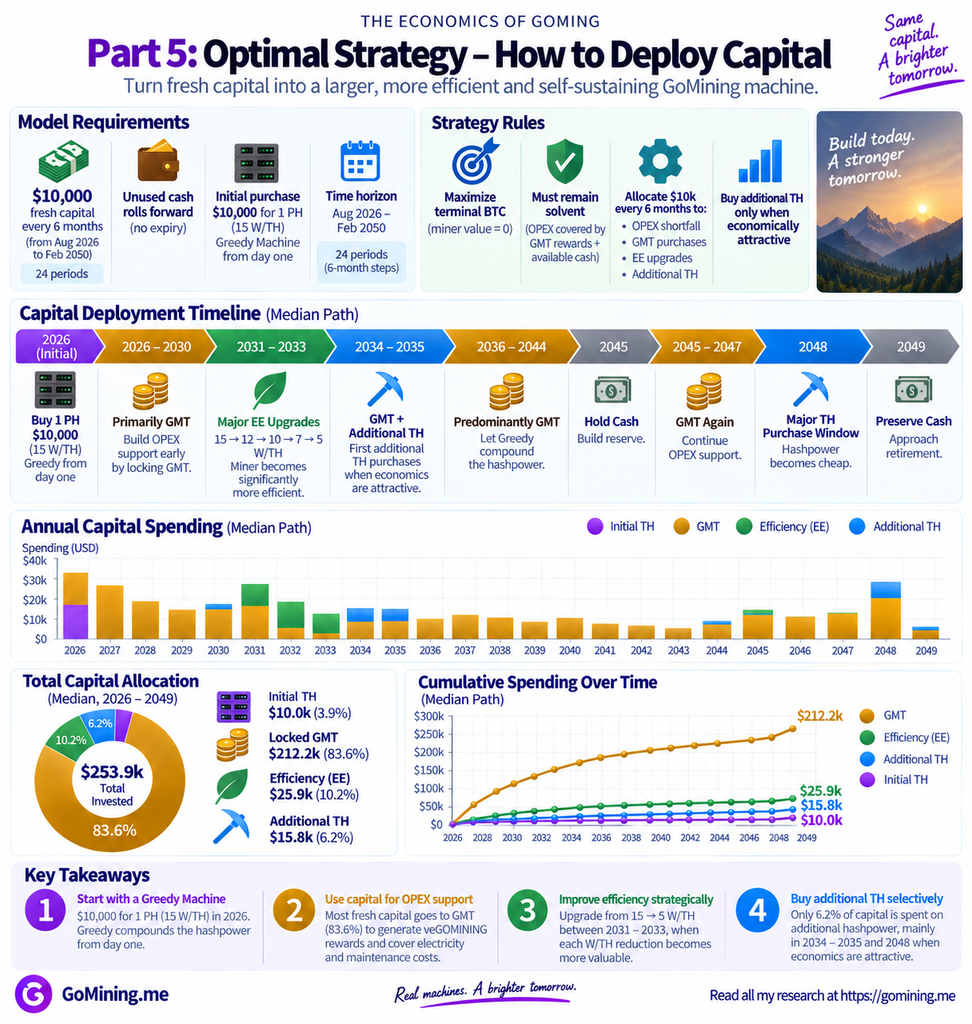
The Optimal GoMining Strategy: Starting Assumptions
The strategy starts in 2026 with:
- $10,000 initial investment
- 1 PH (1,000 TH)
- 15 W/TH
- The entire starting 1 PH is a Greedy Machine from day one
The Greedy Machine therefore begins compounding its hashpower immediately.
For readers unfamiliar with the underlying mining products, the official GoMining website provides more information about its digital miners, Greedy Machine, token ecosystem and mining infrastructure.
After the initial investment, another $10,000 of fresh capital becomes available every six months through 2049.
Unused cash does not disappear. It rolls forward and remains available for future opportunities.
At every six-month decision point, the strategy can deploy capital into:
- Locked GMT
- Energy-efficiency upgrades
- Additional TH
- Cash reserves
The model uses an eight-year forward economic test to decide which investment makes the most sense at each point in time.
Optimal GoMining Strategy: Where Does the Capital Go?
The allocation is surprisingly concentrated.
Across the median simulation, approximately:
| Capital Allocation | Median Spending | Share |
|---|---|---|
| Locked GMT | $212,200 | 83.6% |
| Energy Efficiency | $25,900 | 10.2% |
| Additional TH | $15,800 | 6.2% |
These figures exclude the initial $10,000 purchase of the 1 PH miner.
The largest allocation by far is therefore not additional hashpower.
It is locked GMT.
Why?
Because a growing miner also creates a growing electricity and maintenance bill. Locked GMT generates recurring veGOMINING rewards that can help support those operating costs.
Phase 1 — Build OPEX Support With GMT
2026–2030
During the first several years, the model directs most fresh capital toward locked GMT.
This is an important result.
Instead of immediately using every new dollar to make the miner larger, the strategy first builds the financial infrastructure needed to support future growth.
Greedy is already increasing hashpower organically.
Buying more TH would accelerate growth further — but it would also immediately increase electricity and maintenance costs.
GMT therefore becomes the foundation supporting the growing machine.
Phase 2 — Improve Energy Efficiency
2031–2033
The strategy changes significantly around 2031.
The median path begins a sequence of major EE upgrades:
15 → 12 → 10 → 7 → 5 W/TH
By roughly 2033, the miner has moved from 15 W/TH to approximately 5 W/TH.
This demonstrates an important interaction between Greedy and energy efficiency.
As Greedy compounds the miner’s hashpower, every reduction in W/TH applies across an increasingly large mining operation.
In other words:
Greedy makes energy efficiency increasingly valuable.
EE is therefore not primarily about owning the newest technology. It is about reducing the operating cost of a machine that is becoming progressively larger.
Phase 3 — Buy Additional TH Selectively
2034–2035
The model eventually starts buying additional TH.
But it does not buy continuously.
The first meaningful additional-TH purchases occur around 2034–2035, when the economics become attractive.
After that, the strategy largely steps away from buying hashpower again.
Greedy continues doing the heavy lifting.
Let Greedy Compound the Hashpower
2036–2044
During much of this period, fresh capital again goes predominantly toward GMT.
Meanwhile, the existing Greedy Machine continues compounding.
The approximate median hashpower path illustrates how powerful this becomes:
| Year | Median Hashpower |
|---|---|
| 2026 | 1.00 PH |
| 2030 | 1.52 PH |
| 2033 | 2.67 PH |
| 2036 | 4.42 PH |
| 2040 | 6.95 PH |
| 2045 | 11.53 PH |
| 2050 | 21.13 PH |
The important point is that this growth is not primarily purchased hashpower.
Most of it comes from Greedy compounding.
That fundamentally changes how fresh capital should be viewed.
Phase 4 — Buy TH When Hashpower Becomes Cheap
2048
A second major additional-TH purchase window appears around 2048.
By this point, modeled TH prices have depreciated sufficiently for additional hashpower to become economically attractive again.
This produces one of the clearest findings from the entire simulation:
Do not buy additional TH simply because capital is available. Buy it when the economics make it attractive.
Only about $15,800 of median fresh capital is ultimately spent on additional TH.
That is just 6.2% of subsequent deployed capital.
What Does the Optimal GoMining Strategy Build by 2050?
After almost 24 years of accumulation, the 10,000 simulations produce the following outcomes:
| 2050 Position | P25 | Median | P75 |
|---|---|---|---|
| BTC | 3.320 | 3.775 | 4.276 |
| Hashpower | 16.40 PH | 21.13 PH | 25.62 PH |
| Energy Efficiency | 5 W/TH | 5 W/TH | 10 W/TH |
| Locked GMT | 649,000 | 1.117M | 1.945M |
| Cash | $647 | $5,970 | $24,124 |
The median strategy therefore enters 2050 with approximately:
3.78 BTC + 21.13 PH + 5 W/TH + 1.12 million locked GMT + $6,000 cash.
But the composition is more important than the headline size.
The strategy has built not just a large miner, but a system around that miner.
The Four Roles in the Optimal GoMining Strategy
Greedy = Growth
Greedy compounds the hashpower.
Instead of continually spending fresh capital on TH, the existing mining base increasingly provides its own growth.
Energy Efficiency = Endurance
As the miner becomes larger, electricity efficiency matters more.
Reducing W/TH lowers the operating burden across the entire growing mining base.
GMT = OPEX Support
Locked GMT creates recurring rewards that can help cover electricity and maintenance.
That explains why GMT receives the largest share of fresh capital in the simulation.
Additional TH = Opportunistic
Additional TH still has a role.
But the model buys it selectively when hashpower economics become sufficiently attractive rather than treating TH accumulation as the default use of capital.
Does the Strategy Depend on Greedy Growing Forever?
There is an obvious risk in this analysis.
What happens if Greedy eventually stops compounding?
I therefore took the actual simulated 2050 portfolios and ran a much harsher retirement test where Greedy growth falls to zero after 2050.
The median result still produced approximately:
- 5.33 BTC withdrawn between 2050 and 2090
- 4.01 BTC remaining in 2090
The median system also required only about 0.72 BTC to cover residual mining OPEX across the retirement simulation.
This is important because the Part 5 strategy does not require another 40 years of Greedy compounding to remain economically meaningful.
Future Greedy growth becomes upside rather than a requirement for the basic retirement case.
The Biggest Lesson From Part 5
The optimal GoMining strategy is not about maximizing any single component.
It is about allowing the components to perform different jobs.
Greedy grows the machine.
EE keeps the machine efficient.
GMT helps support the machine’s operating costs.
Additional TH is purchased when the economics justify it.
That leads to the simplest summary of Part 5:
Let Greedy grow the machine. Use capital to support it.
Next — Can GoMining Fund a Retirement?
Part 5 has answered the accumulation question.
Starting with 1 PH in 2026 and deploying fresh capital strategically, the median simulation reaches 2050 with BTC, substantial hashpower, improved energy efficiency, locked GMT and a cash reserve.
But building the system is only half the experiment.
The next question is much harder:
Can that system actually fund retirement?
In Part 6 of The Economics of Goming, I will take the actual 10,000 simulated portfolios produced in Part 5 and move them directly into retirement.
No resetting the miner.
No constructing an average portfolio.
And no starting the simulation again.
The exact Part 5 outcomes become the starting point for Part 6.
This analysis uses Monte Carlo simulations and modeling assumptions involving Bitcoin price, mining difficulty, GMT rewards, Greedy Machine growth, energy-efficiency costs, hashpower prices and other variables. The results are simulations, not predictions of future returns or financial advice.
Leave a Reply