You already went 100% TH. If you’re now looking at the GoMining 100% TH strategy, the next question isn’t simply whether you should keep buying more TH. Your farm is already producing BTC, so the more interesting question is what you should do with that BTC once the Farm has been built.
Should every dollar of mining revenue remain BTC, or should some of that BTC be converted into GMT to reduce OPEX, build maintenance coverage, and potentially generate additional GMT rewards?
I wanted to answer that question quantitatively.
So I ran a 4-year, 50,000-path Monte Carlo simulation comparing three strategies for a 1,000 TH GoMining farm.
The obvious answer is:
Keep buying more TH.
But once you already have a meaningful farm, there is another question worth asking:
Should every dollar of mining revenue remain BTC, or should some of that BTC be redirected into GMT to reduce OPEX, build coverage, and potentially generate additional rewards?
I wanted to answer that question quantitatively.
So I ran a 4-year, 50,000-path Monte Carlo simulation comparing three strategies for a 1,000 TH GoMining farm.
The central idea is simple:
Convert BTC earnings to GMT, and lock it strategically to get more rewards. Build your Farm around your army now.
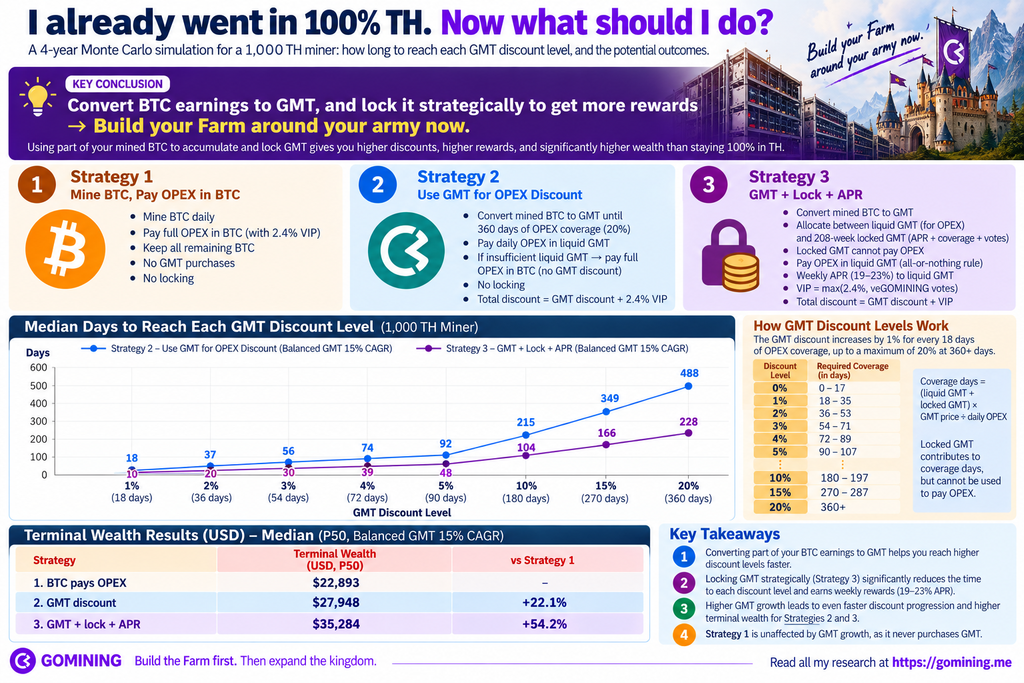
GoMining 100% TH Strategy: The Three Paths
The simulation compares three different ways of managing the BTC produced by the farm.
Strategy 1: Keep the BTC
The simplest approach:
- Mine BTC.
- Pay OPEX in BTC.
- Keep the remaining BTC.
- No GMT purchases.
- No GMT locking.
This is the benchmark.
The problem with simply keeping everything in BTC is that your farm still has to pay its operating costs. That creates a cost that is easy to overlook — the hidden cost of selling BTC to pay for OPEX.
Strategy 2: Convert BTC into GMT for OPEX discounts
This is where the Build the Farm first principle becomes important: establish enough mining capacity to create a meaningful BTC cash-flow engine before using that cash flow to expand the wider ecosystem position.
Here, some mined BTC is converted into GMT.
The objective is to build GMT coverage and qualify for higher maintenance discounts.
The strategy:
- Mine BTC.
- Convert some BTC into GMT.
- Build GMT coverage.
- Use liquid GMT to pay OPEX.
- Keep the remaining BTC as BTC.
Strategy 3: GMT + Strategic Locking + APR
This takes Strategy 2 one step further.
The GMT position is divided between:
- Liquid GMT for paying OPEX.
- Locked GMT for coverage, veGOMINING and rewards.
The model uses a 208-week lock.
Locked GMT receives a stochastic APR between 19% and 23%, with 22% as the mode.
This creates a different economic structure around the mining farm.
GoMining 100% TH Strategy: Start With the Mining Math
The simulated farm starts with:
- 1,000 TH
- 12 W/TH
- BTC price: $84,000
- GMT price: $0.37
- Network difficulty: 132.7571T
- Electricity: $0.05/kWh
- Maintenance/service: $0.0089/TH/day
- Minimum VIP discount: 2.4%
- Four-year simulation
- 50,000 Monte Carlo paths
BTC is kept at the Balanced regime: 15% CAGR.
GMT is the variable in the sensitivity analysis:
| Scenario | BTC CAGR | GMT CAGR |
|---|---|---|
| Hostile GMT | 15% | 7.5% |
| Balanced GMT | 15% | 15% |
| Favourable GMT | 15% | 30% |
The GMT labels refer only to GMT.
BTC stays at 15% CAGR in all three scenarios.
How Much BTC Does 1,000 TH Produce?
The starting mining output is calculated from hashrate, network difficulty and block reward.
The equation is:
BTC mined per day = Miner hashrate × 86,400 × block reward ÷ (difficulty × 2³²)
For this simulation:
Miner hashrate = 1,000 × 10¹² hashes/second
Block reward = 3.125 BTC
Difficulty = 132.7571 × 10¹²
This produces approximately:
0.00047353 BTC/day
At $84,000/BTC:
0.00047353 × $84,000 = $39.78/day
So the farm starts by producing approximately:
$39.78/day of BTC revenue.
That is the economic fuel for all three strategies.
GoMining 100% TH Strategy: Calculate the OPEX
The first expense is electricity.
At 1,000 TH and 12 W/TH:
1,000 TH × 12 W/TH = 12,000 W
That is:
12 kW
Over 24 hours:
12 kW × 24 = 288 kWh/day
At $0.05/kWh:
288 × $0.05 = $14.40/day
Maintenance/service:
1,000 TH × $0.0089 = $8.90/day
Therefore:
Base OPEX = $14.40 + $8.90 = $23.30/day
So the farm starts with:
Mining revenue: $39.78/day
Base OPEX: $23.30/day
GoMining 100% TH Strategy: What Happens If You Keep Everything in BTC?
Strategy 1 receives the minimum 2.4% VIP discount.
Therefore:
Discounted OPEX = $23.30 × (1 − 0.024)
Discounted OPEX = $22.7408/day
Initial operating surplus:
$39.7764 − $22.7408 = $17.0356/day
So the basic cash flow is:
BTC mined → BTC retained → BTC used to pay OPEX
There is no GMT position.
This makes Strategy 1 our control group.
GoMining 100% TH Strategy: How GMT Creates OPEX Coverage
Strategy 2 changes what happens to part of the BTC produced by the farm.
Instead of keeping everything in BTC, some BTC is converted into GMT.
Why?
Because GMT holdings can create maintenance-fee coverage.
The coverage calculation is:
Coverage days = (Liquid GMT + Locked GMT) × GMT price ÷ Base daily OPEX
The important detail is that both liquid and locked GMT contribute to the coverage calculation.
However, locked GMT cannot directly pay today’s OPEX.
The maintenance discount is calculated as:
GMT discount = minimum of 20% and floor(Coverage days ÷ 18)%
This produces the following schedule:
| OPEX coverage | GMT discount |
|---|---|
| 0–17 days | 0% |
| 18–35 days | 1% |
| 36–53 days | 2% |
| 54–71 days | 3% |
| 72–89 days | 4% |
| 90–107 days | 5% |
| 180–197 days | 10% |
| 270–287 days | 15% |
| 360+ days | 20% |
Therefore, the maximum GMT discount requires:
360+ days of coverage.
How Much GMT Represents 360 Days of Coverage?
At the starting base OPEX:
360 × $23.30 = $8,388
At the starting GMT price of $0.37:
$8,388 ÷ $0.37 = 22,670 GMT
So, at the starting assumptions, approximately 22.7k GMT represents 360 days of base OPEX.
But this is only a starting-point calculation.
The Monte Carlo simulation continuously changes:
- BTC price
- GMT price
- network difficulty
- mining output
- OPEX
- GMT holdings
Therefore, the actual amount of GMT required for 360 days changes over time.
GoMining 100% TH Strategy: The BTC-to-GMT Conversion Math
This is one of the most important parts of the model.
Converting BTC into GMT does not create new wealth.
It changes the form of the asset.
The model applies a 2.25% BTC-to-GMT conversion friction.
The equation is:
GMT received = BTC converted × BTC price × (1 − 0.0225) ÷ GMT price
For example, suppose:
BTC converted = 0.01 BTC
BTC price = $84,000
The BTC value is:
0.01 × $84,000 = $840
After the 2.25% conversion friction:
$840 × 0.9775 = $821.10
At $0.37/GMT:
$821.10 ÷ $0.37 = 2,219 GMT
So $840 of BTC becomes approximately 2,219 GMT.
The $18.90 difference is the modeled conversion friction.
The model does not count the original BTC and the resulting GMT as two separate assets.
GoMining 100% TH Strategy: How Strategy 3 Allocates the GMT
This is where Strategy 3 becomes different.
After BTC is converted into GMT, the GMT position has two purposes.
Liquid GMT
Liquid GMT is the spending account.
It is used to pay the daily OPEX.
Locked GMT
Locked GMT:
- contributes to maintenance coverage,
- generates veGOMINING,
- earns weekly GMT rewards.
The complete cash-flow structure is therefore:
Mining Farm
↓
BTC mined
↓
BTC is either retained or converted into GMT
↓
GMT is allocated between liquid GMT and locked GMT
Liquid GMT pays OPEX.
Locked GMT contributes to coverage and generates rewards.
This is the economic structure being tested.
GoMining 100% TH Strategy: The 7-Day Liquid GMT Reserve
The simulation does not lock every GMT.
It maintains a 7-day base-OPEX liquid reserve.
This is a modeling assumption, not a GoMining requirement.
Starting reserve:
7 × $23.30 = $163.10
At $0.37/GMT:
$163.10 ÷ $0.37 = 440.8 GMT
So the model attempts to maintain approximately 441 GMT as a liquid operational reserve at the starting price.
GMT above the modeled reserve can be allocated toward the 208-week lock.
This is important because otherwise the strategy could lock too much GMT and leave itself unable to pay the daily bills.
GoMining 100% TH Strategy: Locked GMT Is Not Spendable GMT
This distinction is critical.
Locked GMT contributes to the coverage calculation:
Coverage = Liquid GMT + Locked GMT
But locked GMT cannot directly pay today’s OPEX.
Therefore:
Liquid GMT = spending asset
Locked GMT = coverage + rewards + voting asset
This means Strategy 3 is not simply moving all GMT into a lock.
It maintains a liquid operating buffer while building a longer-term locked reserve.
GoMining 100% TH Strategy: The 208-Week Lock
For a 208-week lock:
veGOMINING = Locked GMT × Weeks remaining ÷ 208
Suppose 10,000 GMT is locked for the full 208 weeks:
10,000 × 208 ÷ 208 = 10,000 veGOMINING
After 104 weeks:
10,000 × 104 ÷ 208 = 5,000 veGOMINING
So voting power declines linearly as the lock approaches expiry.
How Locked GMT Earns Rewards
The model uses a stochastic GMT APR between 19% and 23%, with 22% as the mode.
Weekly GMT reward:
GMT reward = Locked GMT × APR ÷ 52
For 10,000 locked GMT at 22%:
10,000 × 0.22 ÷ 52 = 42.31 GMT/week
At 19%:
10,000 × 0.19 ÷ 52 = 36.54 GMT/week
At 23%:
10,000 × 0.23 ÷ 52 = 44.23 GMT/week
The reward is paid in GMT.
It is not additional BTC mining revenue.
GoMining 100% TH Strategy: Where Does the BTC Actually Go?
This is perhaps the most important cash-flow clarification.
Suppose the farm produces:
$100 of BTC
The strategy might decide to convert:
$20 of BTC into GMT
After 2.25% conversion friction:
$20 × 0.9775 = $19.55
of economic value reaches GMT.
The remaining:
$100 − $20 = $80
remains BTC.
So the portfolio has effectively changed from:
$100 BTC
to:
$80 BTC + $19.55 GMT
The missing $0.45 is the conversion friction.
There is no double counting.
The GMT position is created by sacrificing part of the BTC position.
GoMining 100% TH Strategy: How GMT Pays the Bills
Suppose GMT coverage reaches 180 days.
That corresponds to a 10% GMT discount.
Add the 2.4% VIP discount:
Total discount = 10% + 2.4% = 12.4%
Daily OPEX becomes:
$23.30 × (1 − 0.124)
= $20.41/day
That $20.41 is paid from liquid GMT.
The locked GMT remains locked.
What Happens If Liquid GMT Is Not Enough?
The simulation uses an all-or-nothing GMT payment rule.
If liquid GMT can pay the full discounted OPEX:
Liquid GMT pays OPEX
and the discount applies.
If liquid GMT cannot pay the entire OPEX:
BTC pays the full OPEX
and the GMT discount does not apply that day.
If neither GMT nor BTC can cover OPEX:
Mining pauses for that day.
The miner is not liquidated.
So the hierarchy is:
Sufficient liquid GMT → pay discounted OPEX
Insufficient liquid GMT but sufficient BTC → pay full OPEX in BTC
Neither sufficient → pause mining for the day
Under the calibrated base simulation, no path required a mining pause.
GoMining 100% TH Strategy: Why Strategy 3 Reaches Discounts Faster
Now we can understand the difference between Strategy 2 and Strategy 3.
Strategy 2 is primarily accumulating liquid GMT.
Strategy 3 has both:
Liquid GMT + Locked GMT
counting toward coverage.
The median Balanced GMT simulation produced:
| GMT discount | Strategy 2 | Strategy 3 |
|---|---|---|
| 1% | 18 days | 10 days |
| 2% | 37 days | 20 days |
| 3% | 56 days | 30 days |
| 4% | 74 days | 39 days |
| 5% | 92 days | 48 days |
| 10% | 215 days | 104 days |
| 15% | 349 days | 166 days |
| 20% | 488 days | 228 days |
The difference at the maximum discount is:
488 − 228 = 260 days
So Strategy 3 reaches the 20% GMT discount approximately 260 days earlier in the median simulation.
That is the practical benefit of building a locked GMT reserve rather than treating GMT purely as a liquid OPEX wallet.
GoMining 100% TH Strategy: GMT Growth Sensitivity
Now we can test how dependent the results are on GMT performance.
BTC remains fixed at 15% CAGR.
Only GMT changes.
Hostile GMT
GMT grows at half the BTC CAGR:
15% × 0.5 = 7.5% CAGR
Balanced GMT
GMT grows at the same rate as BTC:
15% × 1.0 = 15% CAGR
Favourable GMT
GMT grows at twice the BTC CAGR:
15% × 2.0 = 30% CAGR
Therefore:
| Scenario | BTC CAGR | GMT CAGR |
|---|---|---|
| Hostile GMT | 15% | 7.5% |
| Balanced GMT | 15% | 15% |
| Favourable GMT | 15% | 30% |
Again, these labels refer only to GMT.
Starting and Terminal GMT Price Assumptions
Starting GMT price:
$0.37
If GMT grows deterministically at 7.5% for four years:
$0.37 × 1.075⁴ = approximately $0.490
At 15%:
$0.37 × 1.15⁴ = approximately $0.647
At 30%:
$0.37 × 1.30⁴ = approximately $1.057
The actual simulation includes volatility, so these are the deterministic growth components rather than guaranteed terminal prices.
GoMining 100% TH Strategy: Four-Year Wealth Results
For each of the 50,000 Monte Carlo paths, terminal wealth is calculated as:
Terminal wealth = BTC value + liquid GMT value + locked GMT value + terminal TH value
The terminal TH value is modeled at:
$9,495
So:
Terminal wealth = (BTC × BTC price) + ((Liquid GMT + Locked GMT) × GMT price) + $9,495
We then take the median of the 50,000 outcomes.
Hostile GMT: 7.5% CAGR
| Strategy | Median terminal wealth |
|---|---|
| BTC pays OPEX | $22,893 |
| GMT discount | $25,636 |
| GMT + Lock + APR | $31,971 |
Strategy 2 versus Strategy 1:
($25,636 − $22,893) ÷ $22,893 = 12.0%
Strategy 3 versus Strategy 1:
($31,971 − $22,893) ÷ $22,893 = 39.7%
Balanced GMT: 15% CAGR
| Strategy | Median terminal wealth |
|---|---|
| BTC pays OPEX | $22,893 |
| GMT discount | $27,948 |
| GMT + Lock + APR | $35,284 |
Strategy 2 versus Strategy 1:
($27,948 − $22,893) ÷ $22,893 = 22.1%
Strategy 3 versus Strategy 1:
($35,284 − $22,893) ÷ $22,893 = 54.2%
Favourable GMT: 30% CAGR
| Strategy | Median terminal wealth |
|---|---|
| BTC pays OPEX | $22,893 |
| GMT discount | $32,575 |
| GMT + Lock + APR | $42,893 |
Strategy 2 versus Strategy 1:
($32,575 − $22,893) ÷ $22,893 = 42.3%
Strategy 3 versus Strategy 1:
($42,893 − $22,893) ÷ $22,893 = 87.4%
GoMining 100% TH Strategy: Why Strategy 1 Doesn’t Change
There is an important control in this sensitivity analysis.
Strategy 1 produces the same median terminal wealth in all three GMT scenarios:
$22,893
Why?
Because Strategy 1 doesn’t own GMT.
Changing GMT’s growth rate therefore has no direct effect on Strategy 1.
This confirms that the sensitivity is actually testing GMT exposure, rather than secretly changing the overall BTC environment.
The Real Trade-Off in the GoMining 100% TH Strategy
It would be misleading to describe Strategy 3 as “free yield.”
It isn’t.
Every BTC converted into GMT is BTC that you no longer hold.
The strategy is making an allocation decision.
You are exchanging some BTC exposure for:
- OPEX discounts
- GMT coverage
- locked GMT
- GMT rewards
- veGOMINING
- potential GMT appreciation
But you also take on:
- BTC-to-GMT conversion friction
- GMT price risk
- lock-up risk
- changing voting power
- opportunity cost from holding less BTC
That’s exactly why the math matters.
GoMining 100% TH Strategy: Build the Farm First
I don’t think the conclusion from this analysis is:
“Stop buying TH.”
The first step is still to Build the Farm.
TH is the mining engine.
Without TH, there is no mining production.
But once you have built a meaningful farm, the question changes.
Instead of asking only:
“How much more TH can I buy?”
you can ask:
“How do I make the TH I already own increasingly self-supporting?”
That is a different question.
Build Your Farm Around Your Army
Think of your TH as the army.
The army produces BTC.
But the army also has operating costs.
Electricity.
Maintenance.
Infrastructure.
GMT can become part of the economic infrastructure supporting that army.
The model therefore creates a cycle:
TH produces BTC.
Some BTC remains BTC.
Some BTC becomes GMT.
GMT creates OPEX coverage.
Higher coverage creates larger discounts.
Some GMT can be strategically locked.
Locked GMT contributes to coverage and earns GMT rewards.
Those rewards can strengthen the GMT position further.
The objective isn’t simply to have the biggest army.
It is to build the economic structure that supports the army.
GoMining 100% TH Strategy: The Farm-Building Flywheel
The concept can be summarized as:
Build the Farm
↓
Generate BTC
↓
Convert part of BTC into GMT
↓
Build OPEX coverage
↓
Reduce OPEX
↓
Strategically lock surplus GMT
↓
Earn GMT rewards and build veGOMINING
↓
Strengthen the economic base of the Farm
↓
Use future surplus to expand again
This is what I mean by:
Build your Farm around your army.
The Bottom Line
If you’ve already gone 100% TH, you don’t necessarily have to think that your only next move is buying more TH.
Your farm is already producing BTC.
The next question is what you do with that production.
Under the assumptions in this simulation, converting some BTC into GMT and strategically locking GMT produced substantially higher median terminal wealth than simply keeping BTC and paying OPEX in BTC.
But the result depends heavily on GMT performance.
That’s why I ran three GMT scenarios:
- Hostile GMT: 7.5% CAGR
- Balanced GMT: 15% CAGR
- Favourable GMT: 30% CAGR
BTC remains fixed at 15%.
The Balanced GMT scenario produced a median terminal wealth of:
$22,893 — BTC-only
versus:
$27,948 — GMT discount
and:
$35,284 — GMT + Lock + APR
The model therefore suggests a potentially important shift in thinking:
Once you’ve built the Farm, don’t just think about building more TH. Think about building the economic infrastructure around the TH you already own.
Build the Farm first.
Then build your kingdom around your army.
Simulation Assumptions
For transparency, the key assumptions were:
- Simulation period: 28 Sep 2026 to 28 Sep 2030
- 50,000 Monte Carlo paths
- Starting miner: 1,000 TH
- Efficiency: 12 W/TH
- Starting BTC: $84,000
- Starting GMT: $0.37
- BTC CAGR: 15%
- GMT CAGR sensitivity: 7.5%, 15%, 30%
- BTC annual volatility: 60%
- GMT idiosyncratic volatility: 35%
- BTC/GMT return correlation: 0.431
- Starting difficulty: 132.7571T
- Electricity: $0.05/kWh
- Maintenance/service: $0.0089/TH/day
- BTC-to-GMT conversion friction: 2.25%
- Maximum GMT maintenance discount: 20%
- Minimum VIP: 2.4%
- Lock duration: 208 weeks
- GMT APR: 19–23% stochastic range, 22% mode
- Strategy 3 liquid reserve: 7 days of base OPEX
- Terminal TH value: $9,495
The 7-day liquid GMT reserve is a modeling assumption, not a GoMining requirement.
If liquid GMT cannot cover the discounted OPEX for a day, the model pays the full OPEX in BTC if sufficient BTC exists. If neither asset can cover OPEX, mining pauses for that day; the miner is not liquidated.
Under the calibrated base simulation, no path required a mining pause.
Leave a Reply