SimpleEarn TH reinvestment offers an interesting choice: should you use your SimpleEarn rewards to accumulate Bitcoin directly, or take advantage of the +10% boost and reinvest those rewards into mining power?
To find out, I modeled SimpleEarn TH reinvestment against taking the rewards in BTC over five years. The comparison uses 40,000 Monte Carlo paths and accounts for Bitcoin mining difficulty, the 2028 halving, TH price depreciation, a 27% OPEX discount, and the residual value of the miner.
The result was surprisingly clear: reinvesting SimpleEarn into TH produced higher total wealth in 69.4% of simulated paths.
How the SimpleEarn TH Reinvestment Comparison Works
Both strategies start with the same $10,000 USDC in SimpleEarn at an 11.52% annual rate.
Option 1: Take SimpleEarn Rewards in BTC
Option 1 is the benchmark.
The $10,000 remains in SimpleEarn and the 11.52% rewards are accumulated as BTC.
To keep the comparison fair, whenever Option 2 has to inject $1 to purchase GMT for mining OPEX, Option 1 receives the same $1 as additional USDC in SimpleEarn.
This ensures that both strategies receive the same external capital over the five-year period.
Option 2: SimpleEarn TH Reinvestment
Option 2 takes the SimpleEarn rewards as mining power instead.
The TH option receives a 10% boost, making its effective purchasing rate:
11.52% × 1.10 = 12.672% per year into TH.
The miner starts from 0 TH, is non-Greedy, and operates at 15 W/TH.
I assumed a 27% OPEX discount and no EE upgrades during the five-year test.
TH Depreciation Makes Reinvestment More Powerful
One important feature of the model is that I did not assume 15 W/TH remains at $11/TH forever.
My research into GoMining energy efficiency and upgrade timing demonstrates that hardware should become cheaper as newer and more efficient generations arrive.
The modeled 15 W/TH purchase price therefore declines approximately from:
$11.00/TH → $8.91/TH → $7.23/TH.
This means the same SimpleEarn reward buys progressively more mining power.
By the end of five years, the strategy accumulates approximately:
691 TH.
This is an important part of the SimpleEarn TH reinvestment strategy: depreciation is not purely negative. It reduces the residual value of existing TH, but it also allows future rewards to acquire more TH.
SimpleEarn TH Reinvestment Has Real OPEX
More TH also means more electricity and maintenance.
With a 27% discount, cumulative OPEX over the five-year simulation is approximately:
$11,526.
I assume this OPEX is paid by purchasing the necessary GMT.
But that $11,526 isn’t ignored in the BTC benchmark.
Every OPEX dollar injected into Option 2 is matched with an equivalent USDC contribution to Option 1.
This makes the comparison deliberately demanding for the mining strategy.
Bitcoin Halving and Difficulty Are Included
Bitcoin’s block subsidy is programmed to halve every 210,000 blocks. You can explore the underlying Bitcoin issuance and mining data through the Blockchain.com Bitcoin Explorer. The simulation also accounts for the 2028 Bitcoin halving.
The block subsidy falls from:
3.125 BTC → 1.5625 BTC per block.
Mining difficulty is also modeled dynamically rather than remaining fixed. It responds to Bitcoin price and the economics of mining.
This matters because simply projecting today’s BTC production five years into the future would substantially overstate miner output.
SimpleEarn TH Reinvestment: The 5-Year Results
The comparison becomes most interesting when we look at total wealth, rather than BTC production alone.
Total wealth includes BTC, remaining USDC and, for Option 2, the depreciated terminal value of the miner.
The results are calculated path-by-path before taking the P25, P50 and P75 percentiles.
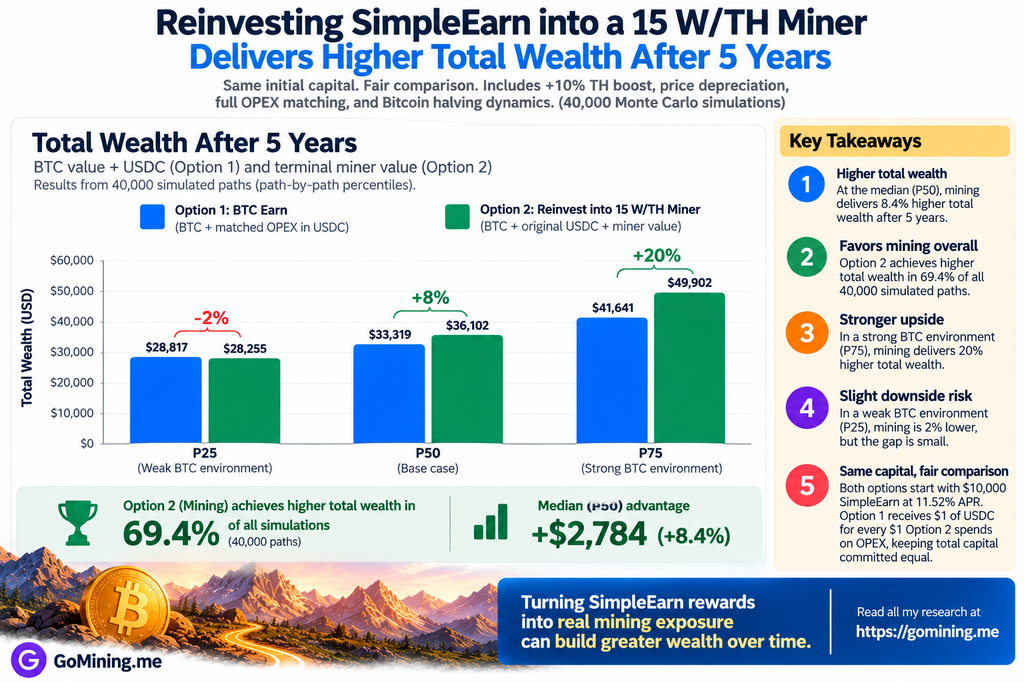
P25: Weak BTC Environment
At P25:
BTC Earn: $28,817
TH Reinvestment: $28,255
Mining finishes approximately 2% behind.
This is the main downside of the strategy.
When the Bitcoin environment is weak, the additional BTC produced by mining isn’t valuable enough to fully compensate for OPEX and miner depreciation.
P50: Base Case
At the median:
BTC Earn: $33,319
TH Reinvestment: $36,102
The SimpleEarn TH reinvestment strategy finishes approximately:
$2,784 ahead, or +8.4%.
This is where the economics become compelling.
The miner has depreciated, OPEX has been fully counted, and the Bitcoin halving has occurred — yet the mining strategy still produces greater median terminal wealth.
P75: Strong BTC Environment
At P75:
BTC Earn: $41,641
TH Reinvestment: $49,902
Mining finishes approximately:
20% ahead.
This highlights an important characteristic of mining: the upside becomes much more powerful when the Bitcoin environment is favorable.
SimpleEarn TH Reinvestment Wins 69.4% of Simulations
Perhaps the most useful result isn’t P50.
It’s the path-by-path win rate.
Across 40,000 Monte Carlo simulations, Option 2 finishes with greater total wealth in:
69.4% of paths.
That does not mean mining wins under every condition.
The P25 result demonstrates that there is genuine downside risk.
But the distribution is asymmetric: the weak-case disadvantage is relatively small, while the stronger Bitcoin environments create considerably greater upside.
Why the +10% TH Boost Matters
Without the SimpleEarn TH bonus, the economics would be less attractive.
Taking rewards as TH effectively turns:
11.52% → 12.672%
of the original SimpleEarn balance into annual mining-power purchasing capacity.
And because the price of older TH declines over time, later rewards acquire more hashing power than earlier rewards.
The combination creates an interesting compounding mechanism:
SimpleEarn rewards → TH → BTC production → depreciating TH allows future rewards to buy even more TH.
Unlike Greedy Machine compounding, this test assumes no automatic TH growth. The advantage comes purely from the SimpleEarn reward stream and the +10% TH incentive.
What This Study Does Not Mean
This isn’t an argument that mining will always outperform accumulating Bitcoin.
The result depends on assumptions about BTC price, mining difficulty, OPEX, TH depreciation and the future economic value of mining hardware.
It also assumes the miner remains at 15 W/TH for the full five years.
Future research could test whether strategically upgrading EE changes the result further.
The purpose of the simulation is narrower: given the same starting SimpleEarn capital and the same subsequent cash injections, which reward choice produces the stronger five-year economic outcome?
Conclusion: SimpleEarn TH Reinvestment Has a Powerful Advantage
The simulation suggests that the +10% SimpleEarn TH option can materially change the economics of reinvesting rewards into mining.
At P25, mining trails BTC Earn by approximately 2%.
At P50, mining leads by 8.4%.
At P75, the advantage expands to approximately 20%.
And across all 40,000 simulated paths, SimpleEarn TH reinvestment produces greater total wealth 69.4% of the time.
The important insight is not simply that mining produces more BTC.
It is that reinvesting SimpleEarn rewards into depreciating TH can convert a passive yield stream into a growing productive mining asset.
Even after accounting for OPEX, TH depreciation and the Bitcoin halving, the five-year simulation strongly favors SimpleEarn TH reinvestment across most modeled paths.
This experiment is part of my broader Economics of Goming research series, where I model the long-term economics of TH, EE, GMT and Bitcoin accumulation.
Monte Carlo simulations are models, not forecasts. Actual results will depend on Bitcoin price, network difficulty, mining fees, TH pricing, GMT pricing and future GoMining economics.
Leave a Reply