The GoMining Trifecta brings together the three forces that can shape a stronger mining system: Greedy Machine, Energy Efficiency, and locked GMT.
Parts 1–3 of The Economics of Goming built the foundation for the GoMining Trifecta.
In Part 1: The Lifetime of a GoMining Miner, I explored how long a miner can remain economically viable and its effective cost of acquiring Bitcoin.
In Part 2: GoMining versus Buying Bitcoin, I tested whether mining can outperform simply buying Bitcoin using the same cash flows.
In Part 3: The Economics of Energy Efficiency, I examined when EE upgrades make economic sense — and why the price paid for efficiency matters.
Part 4 brings those lessons together: Greedy Machine for Power. Energy Efficiency for Endurance. Locked GMT for Wealth.
A strong GoMining strategy has three complementary powers:
Greedy Machine for Power. Energy Efficiency for Endurance. Locked GMT for Wealth.
Together, they form The GoMining Trifecta.
Power: Greedy Machine in the GoMining Trifecta
Greedy Machine compounds mining rewards back into additional TH.
More TH means more hashpower and greater potential Bitcoin production. But there is a trade-off: every additional TH also increases electricity and maintenance costs.
Greedy makes the machine more powerful — but also more expensive to run.
Power needs support.
Endurance: Energy Efficiency in the GoMining Trifecta
Energy Efficiency attacks that growing cost base.
Lower W/TH means less electricity is required for every TH operating in the system. As Greedy Machine increases hashpower, keeping that larger miner efficient becomes increasingly important.
As I explored in Part 3, EE is not simply about owning the newest or most efficient miner. The economics depend heavily on when you upgrade and how much you pay for it.
Its strategic role is simpler:
Greedy grows the machine. EE keeps the machine alive.
Wealth: How Locked GMT Supports the Trifecta
Locked GMT plays a completely different role.
Rather than increasing TH or reducing W/TH, locked GMT generates recurring weekly rewards. At a maximum 208-week lock, my working model assumes approximately 20% annual rewards, paid weekly.
Those rewards can then help fund the miner’s electricity and maintenance.
And importantly, OPEX coverage is not limited to a fixed percentage.
Lock enough GMT and the reward stream could theoretically cover anywhere from 0% to 100% of the miner’s OPEX.
At 100%, the mining operation reaches an interesting milestone: its electricity and maintenance can potentially be supported entirely by the locked-GMT reward stream.
That is why I think of locked GMT as Wealth — an economic reserve supporting the mining machine.
How the GoMining Trifecta Works Together
Put all three together:
Greedy Machine → More TH → More BTC production
Energy Efficiency → Lower cost per TH → Greater endurance
Locked GMT → Recurring rewards → OPEX support
Each solves a different problem.
More importantly, they complement each other.
Greedy increases production — but also increases OPEX.
EE reduces the operating burden of that growing hashpower.
Locked GMT helps pay the remaining operating costs.
The result is not three separate strategies.
It is one mining system.
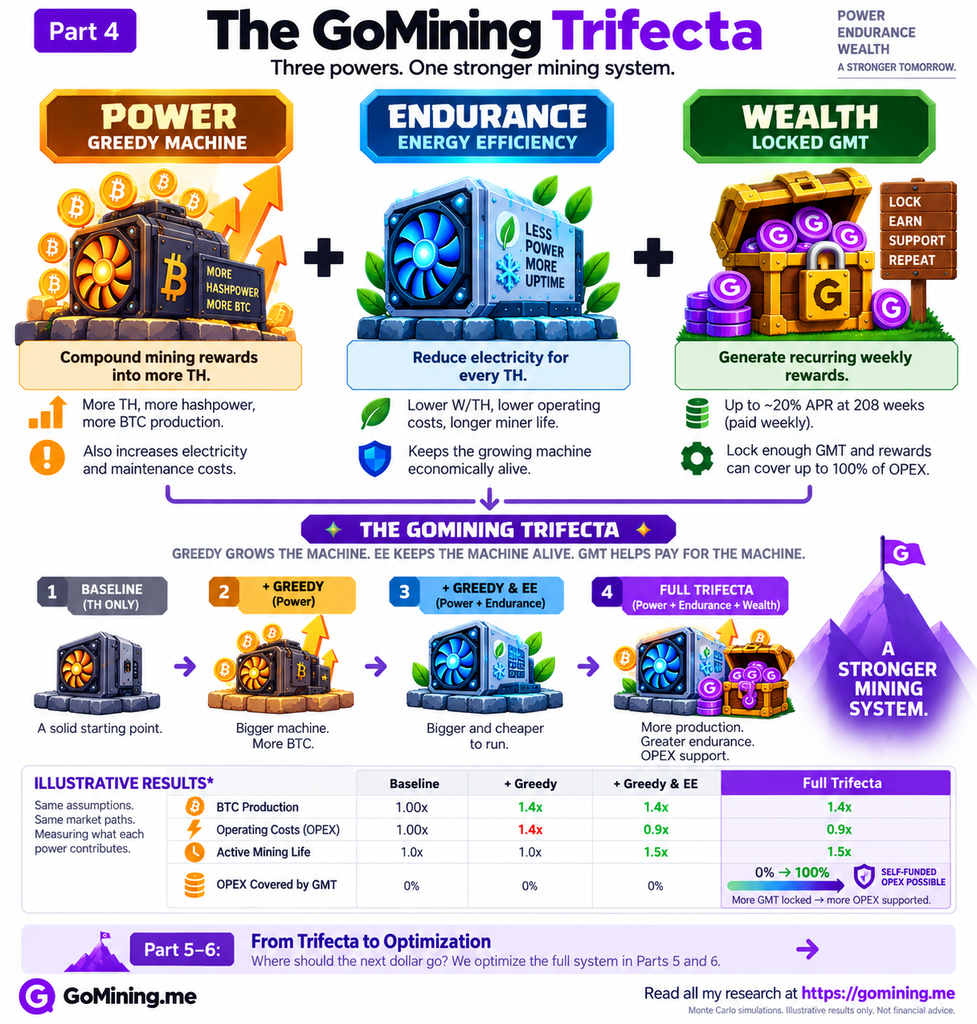
Greedy grows the machine.
EE keeps the machine alive.
GMT helps pay for the machine.
TheTrifecta Is Not Automatically Optimal
There is one important distinction.
Having all three components does not mean capital should be divided equally between them.
There may be periods when buying more TH produces the best return.
There may be times when a cheap EE upgrade is far more valuable.
And there may be a point where increasing the locked-GMT position enough to cover more OPEX becomes the better defensive move.
That creates a much harder question:
Where should the next dollar go?
Parts 5–6: From the Trifecta to Optimization
Part 4 defines the system.
Parts 5 and 6 will test how to actually operate it.
Instead of studying TH, EE and locked GMT separately, the next stage will allow capital to compete between them.
Should the next dollar:
- Increase TH?
- Improve Energy Efficiency?
- Buy and lock more GMT?
- Pay OPEX?
- Or remain in reserve for a better opportunity?
Part 5 will focus on accumulation: how scarce capital should be deployed while the mining system is still growing.
Part 6 will take the resulting mining system into retirement: testing whether Bitcoin withdrawals can be sustained while the miner continues operating without fresh external capital.
The Trifecta tells us what the three powers do.
Parts 5–6 will answer the harder question:
How should we use them?
Explore the complete Economics of Goming research series on GoMining.me.
Disclaimer: This article is part of my ongoing The Economics of Goming research series. The calculations and Monte Carlo simulations used throughout the series depend on assumptions about Bitcoin price, mining difficulty, fees, Energy Efficiency, token rewards and other variables. They are research scenarios, not financial advice.
Leave a Reply