GoMining versus buying Bitcoin is the fundamental comparison every miner should make. If I have $10,000 to deploy, am I better off buying a GoMining miner—or simply buying Bitcoin and holding it?
In Part 1 of The Economics of GoMining, I looked at how much Bitcoin a passive GoMining miner could generate over its economic lifetime. Part 2 raises the bar: can mining actually beat buying Bitcoin outright?
Making GoMining versus buying Bitcoin a fair comparison
The comparison has to account for more than the initial $10,000.
A miner requires electricity, maintenance and potentially future energy-efficiency upgrades. Someone who simply buys Bitcoin does not have these expenses.
So I used a same-cash-flow benchmark. Every dollar spent on mining is matched by an equivalent Bitcoin purchase:
- $10,000 spent buying the miner → $10,000 buys BTC instead.
- $1 spent on electricity or maintenance → $1 buys BTC instead.
- $1 spent upgrading energy efficiency → $1 buys BTC instead.
The miner also receives zero terminal resale value in the model.
This creates a deliberately difficult benchmark for mining to beat.
GoMining versus buying Bitcoin: The Monte Carlo model
I simulated 30,000 Monte Carlo paths over 15 years.
Rather than assuming one future for Bitcoin, the model tests thousands of possible combinations of Bitcoin price and network difficulty.
I tested four broad economic environments:
- Favorable: BTC +20% annually, difficulty +12%.
- Balanced: BTC +15%, difficulty +15%.
- Difficulty Leads: BTC +15%, difficulty +20%.
- Hostile: BTC +10%, difficulty +25%.
These are scenarios, not forecasts.
The miner can also pause when mining becomes unprofitable and restart when conditions improve.
Strategic energy-efficiency upgrades can be made when older EE generations become sufficiently cheap and the upgrade passes an economic test against simply buying BTC.
Six GoMining configurations
I tested two starting miners. Each was tested at three fee levels. For context, GoMining explains how electricity, service costs and available maintenance discounts affect net mining rewards in its official maintenance documentation.
The first spends $10,000 on approximately 1,000 TH at 15 W/TH.
The second spends the same $10,000 on approximately 588.58 TH at 12 W/TH.
Each was tested at three fee levels:
- Full fees: $0.05/kWh electricity and $0.0089/TH/day maintenance.
- 20% discount: $0.04/kWh and $0.00712/TH/day.
- 26% discount: approximately $0.037/kWh and $0.00659/TH/day.
For this experiment, the discounts are treated purely as fee scenarios. The cost of obtaining those discounts through GOMINING token ownership is not yet included.
The results: When does mining beat buying Bitcoin?
The infographic below summarizes the experiment.
Each percentage shows the probability that mining finishes with more Bitcoin than buying BTC outright.
The BTC figure underneath shows the median (P50) BTC advantage or disadvantage.
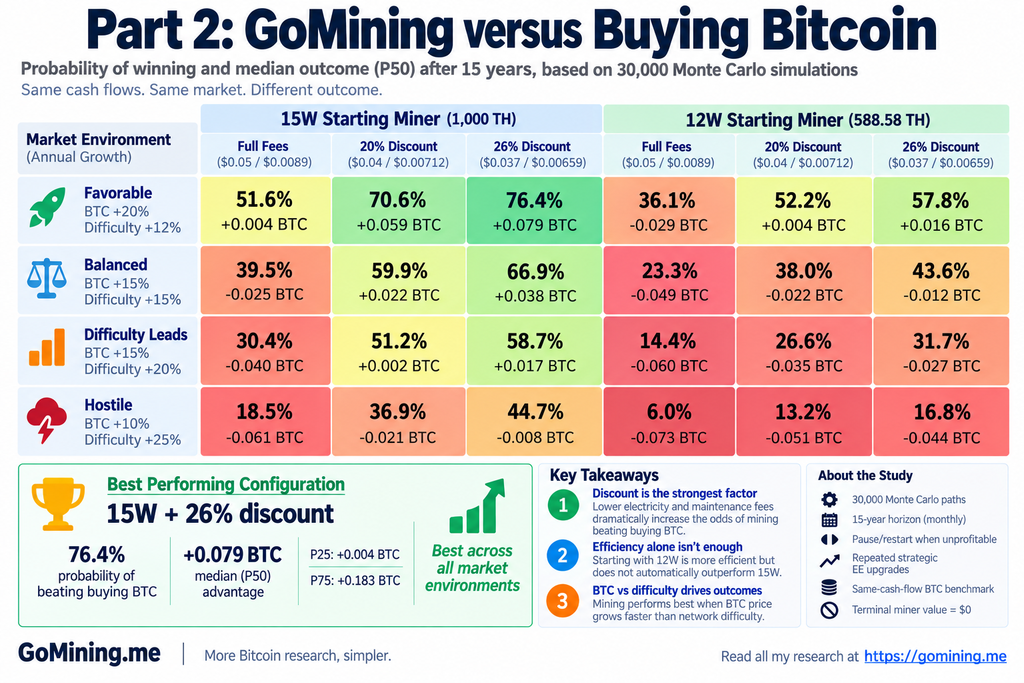
The results reveal a surprisingly strong pattern.
The biggest factor wasn’t energy efficiency—it was the discount
At full fees, mining struggles against buying Bitcoin in most environments.
For the 15 W miner, the probability of beating BTC ranged from 51.6% in the favorable environment to only 18.5% in the hostile environment.
Apply a 20% fee discount, however, and the picture changes dramatically:
- 70.6% — Favorable
- 59.9% — Balanced
- 51.2% — Difficulty Leads
- 36.9% — Hostile
At a 26% discount, the probabilities improve again:
- 76.4% — Favorable
- 66.9% — Balanced
- 58.7% — Difficulty Leads
- 44.7% — Hostile
That is a substantial change produced primarily by reducing recurring operating costs.
Best performing configuration: 15 W + 26% discount
The strongest configuration tested was the 15 W starting miner with a 26% fee discount.
Under the favorable BTC +20% / difficulty +12% environment, mining beat buying Bitcoin in:
76.4% of simulated paths
Its BTC advantage was:
- P25: +0.004 BTC
- P50: +0.079 BTC
- P75: +0.183 BTC
The P25 result is particularly interesting.
Even at the lower quartile, the mining strategy remained slightly ahead of buying Bitcoin outright.
In this environment, more than three quarters of simulations favored mining—and even the lower quartile still produced a small BTC advantage.
Why didn’t the 12 W miner perform better?
This was one of the more interesting findings.
The 12 W miner is clearly more energy efficient.
But $10,000 buys only about 588.58 TH at 12 W/TH, compared with 1,000 TH at 15 W/TH.
You are therefore exchanging a substantial amount of initial hashpower for better energy efficiency.
That trade-off does not automatically maximize Bitcoin accumulation.
For example, under the favorable environment with a 26% discount:
15 W miner: 76.4% probability of beating BTC
12 W miner: 57.8% probability of beating BTC
The most efficient miner is not necessarily the best investment.
Energy efficiency matters—but so does the price paid for that efficiency.
BTC growth versus difficulty still matters
Discounts cannot eliminate the underlying economics of Bitcoin mining.
Mining performs best when Bitcoin’s price grows faster than network difficulty. As difficulty increasingly outruns Bitcoin, mining’s advantage deteriorates.
For the strongest 15 W + 26% discount configuration:
- BTC +20% / Difficulty +12% → 76.4%
- BTC +15% / Difficulty +15% → 66.9%
- BTC +15% / Difficulty +20% → 58.7%
- BTC +10% / Difficulty +25% → 44.7%
Even the strongest configuration cannot guarantee that mining beats Bitcoin.
But lower operating costs substantially expand the range of economic conditions under which it can.
The key lesson from GoMining versus buying Bitcoin
My biggest takeaway from this experiment is simple:
Discount is the strongest factor tested for increasing the probability that mining beats buying Bitcoin outright.
Energy efficiency helps.
Buying hashpower at the right price helps.
Strategic EE upgrades help keep a miner competitive.
And Bitcoin ultimately needs to perform sufficiently well relative to network difficulty.
But among the six configurations tested here, reducing electricity and maintenance costs produced the largest improvement in mining’s competitiveness against simply buying BTC.
In practice, GoMining users can obtain maintenance discounts through several mechanisms, including GOMINING-based maintenance payments and VIP status.
That changes how I think about the economics of GoMining.
The question isn’t simply:
“How efficient is my miner?”
A better question may be:
“How cheaply can I operate each TH I own?”
And that leads directly into Part 3 of The Economics of Goming: when should we actually spend money upgrading energy efficiency—and when is it better to wait?
Disclaimer: This analysis is a simulation, not a forecast or financial advice. Future Bitcoin prices, network difficulty, GoMining fees, miner pricing and energy-efficiency upgrade costs can differ materially from the assumptions used here.
Leave a Reply