The economics of GoMining are more complicated than simply asking whether a miner is profitable. A GoMining miner produces Bitcoin over time, but its real return depends on network difficulty, electricity and maintenance costs, energy efficiency—and what you choose to do with the BTC it generates.
So, is GoMining actually a good investment?
It sounds like a simple question. It isn’t.
Buying a GoMining miner is fundamentally different from simply buying Bitcoin. You acquire productive hashpower that generates BTC over time—but that production comes with ongoing costs, rising network difficulty and eventually technological obsolescence.
And then there are the choices.
Should you reinvest your BTC? Upgrade your miner’s energy efficiency? Lock GOMINING tokens? Use Greedy Machine? Or simply collect the Bitcoin and do nothing?
Each decision changes the economics.
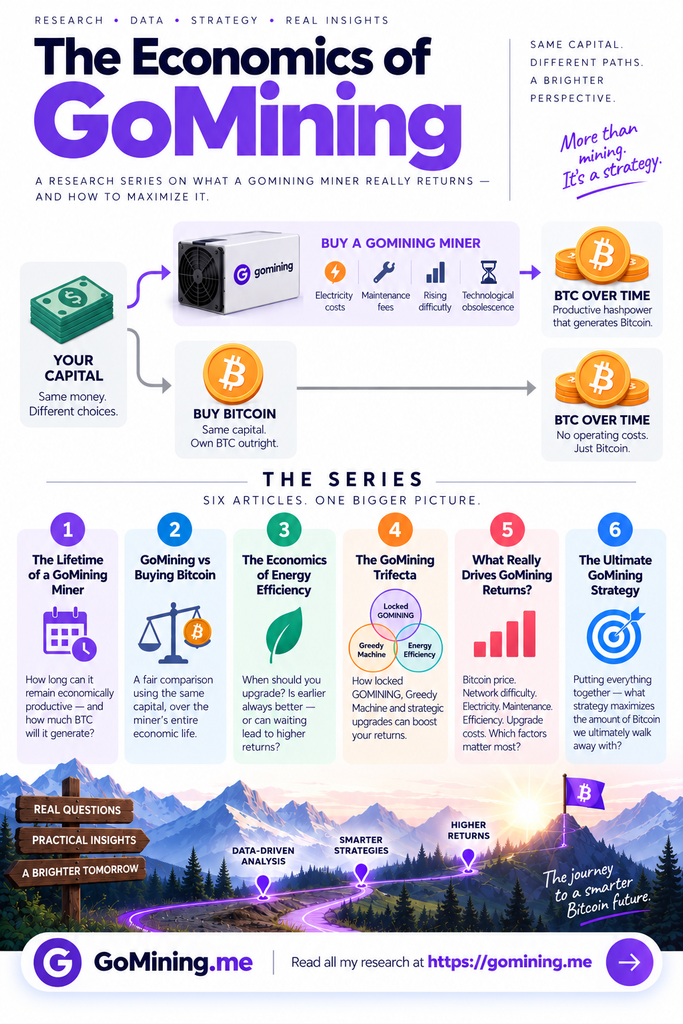
Understanding the Economics of GoMining
Most mining return calculations ask:
How long does it take to earn back the purchase price?
I think that’s the wrong question.
The more important question is:
How much Bitcoin can a GoMining miner generate over its entire economic life—and was buying the miner actually better than simply buying BTC?
That’s what The Economics of GoMining will investigate.
What This Series Will Explore
1. The Lifetime of a GoMining Miner
What happens if you buy a miner and never upgrade it?
We’ll follow a GoMining miner through its entire economic life to see how much BTC it produces, how its profitability changes as network difficulty rises, and when it eventually becomes uneconomic to operate.
2. GoMining vs Buying Bitcoin
What if, instead of buying a miner, you simply bought BTC?
We’ll make this a fair comparison: the same starting capital, the same time period, and the miner followed through its entire economic life.
3. The Economics of Energy Efficiency
Energy efficiency can dramatically change a miner’s operating costs. As I’ve explored in my previous research on GoMining energy efficiency, the cost and timing of an upgrade can matter almost as much as the efficiency improvement itself.
4. The GoMining Trifecta
Then we’ll look at what happens when we stop treating the miner as a passive investment.
We’ll combine three powerful tools:
Locked GOMINING + Greedy Machine + strategic energy-efficiency upgrades.
The question is whether these three mechanisms together can materially increase lifetime BTC returns.
5. What Really Drives GoMining Returns?
Bitcoin price. Network difficulty. Electricity. Maintenance. Energy efficiency. Upgrade costs.
We’ll stress-test these variables to determine which ones actually have the greatest effect on long-term returns—and where the biggest risks lie.
6. The Ultimate GoMining Strategy
Finally, we’ll put everything together.
Starting with a GoMining miner today, we’ll ask:
What strategy maximizes the amount of Bitcoin we ultimately walk away with?
A Better Way to Understand GoMining Returns
Where possible, this series will use historical data, simulations and probabilistic modelling rather than relying on a single BTC price prediction.
And instead of stopping the analysis after an arbitrary three, five or ten years, we’ll follow the economics as far as the question requires.
Because the real question isn’t simply whether a GoMining miner can make money.
It’s whether the return justifies the capital, the costs, the risks—and the Bitcoin you could have bought instead.
Welcome to The Economics of GoMining.
Disclaimer: This series represents independent research and analysis. It is not financial advice.
Leave a Reply