I lived through both. I rode the DeFi Summer of 2020, and I got frozen out by the Crypto Winter of 2022. Like everyone else, COVID lockdowns trapped me at home — and with nothing but time on my hands, I dove headfirst into crypto.
I wasn’t just buying and holding. I ran bots on crypto exchanges, experimented with futures bot trading, and explored blockchains purpose-built for DeFi along with all the tools that came with them — yield farms, liquidity pools, lending protocols, the whole ecosystem. I threw myself into it. Here’s what that experience actually taught me.
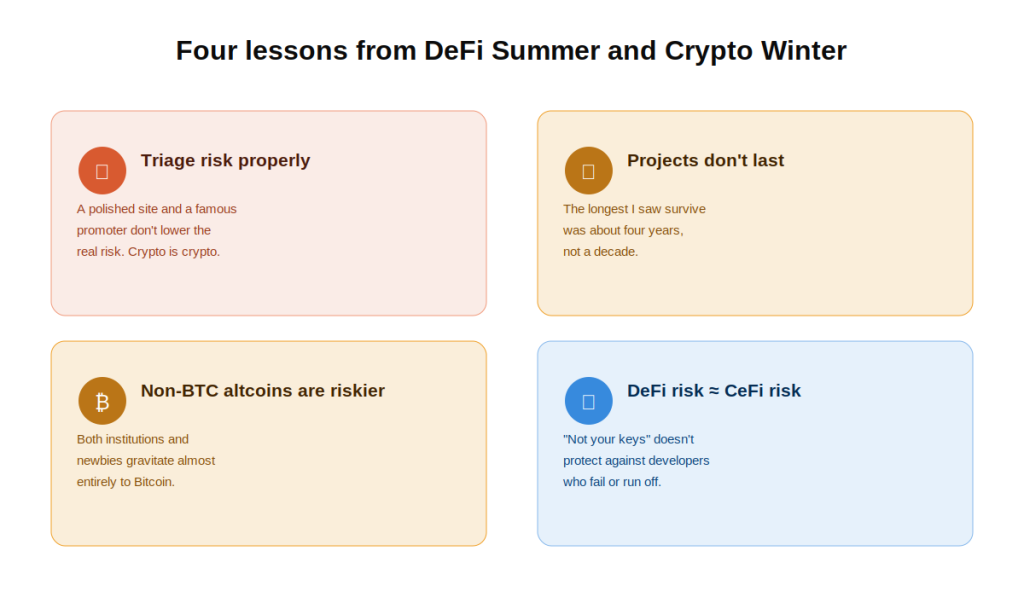
I learnt to triage risk properly — the hard way
I made a naive mistake early on: I assumed that if a project’s website looked professional, its whitepaper read well, and a well-known personality promoted it, the risk must be low. I was wrong. Crypto is crypto, no matter who’s putting their name behind it. A slick landing page and a famous face don’t change the underlying risk profile of an asset one bit. I learnt to actually estimate risk on its own terms, not borrow someone else’s credibility as a shortcut.
I learnt that crypto projects don’t last
I genuinely believed a few of the projects I invested in could run for a decade — real infrastructure, real staying power. I was wrong about that too. The longest-lived project I personally watched survive was maybe four years. Four years, not ten. I had to recalibrate my entire mental model of what “long-term” even means in this space.
I learnt that altcoins disconnected from Bitcoin carry outsized risk
Plenty of the projects I explored had genuinely promising utility — tokens and NFTs tied to real functionality, not just speculation. But I watched, again and again, that both institutional money and newbie retail money gravitate almost exclusively toward Bitcoin. Everything else competes for a much smaller, much more fickle pool of capital. Utility alone doesn’t protect you from that gravitational pull.
I learnt that DeFi risk and CeFi risk aren’t as different as the slogans claim
“Not your keys, not your money” is a great line. It pulled a lot of people, including me, out of centralized exchanges and into DeFi protocols, convinced we were finally safe from counterparty risk. But DeFi has its own counterparty risk — it just wears a different face. Protocol developers can go dark. Smart contracts can get exploited. Teams can quietly appropriate funds just as easily as any centralized exchange executive could. The risk didn’t disappear when I moved from CeFi to DeFi. It just changed shape.
Where all of this left me
After the Crypto Winter hit, I took every one of these lessons seriously — maybe too seriously. I pulled back from almost every crypto project I’d touched and settled into TradFi, figuring I’d learnt my lesson for good.
So what actually pulled me back into crypto — specifically, into GoMining? That’s the next post. Stay tuned.
Leave a Reply