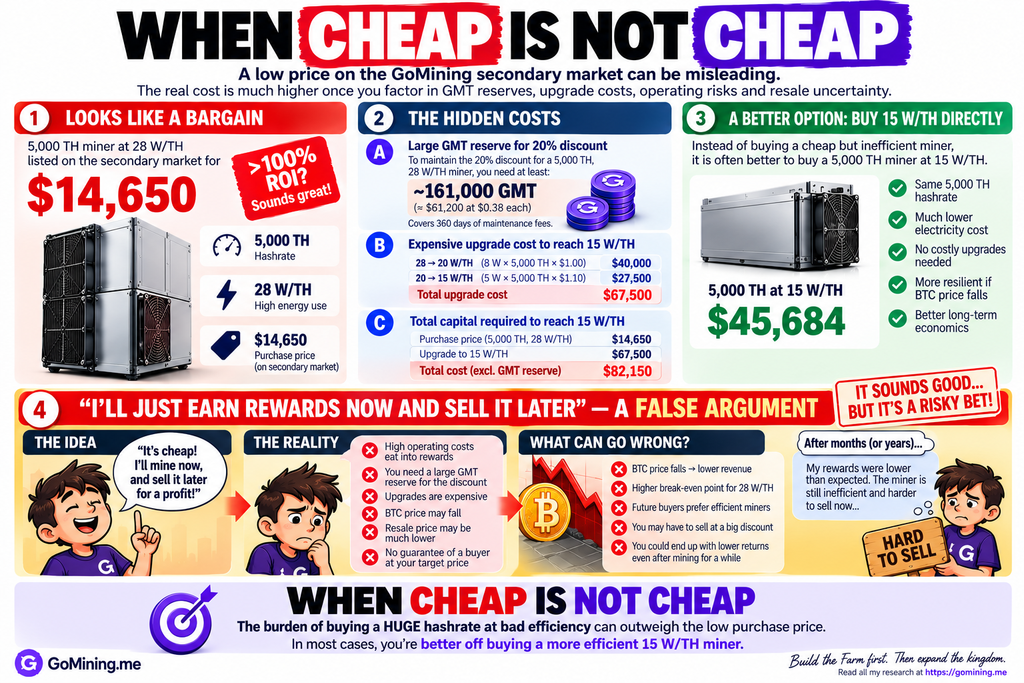
GoMining secondary market miners can look like a bargain, especially when a listing promises a huge hashrate and an advertised ROI of more than 100%. But a low purchase price does not necessarily mean good value. A 5,000 TH miner running at 28 W/TH and listed for $14,650 may appear attractive at first glance, yet its high electricity consumption, potential energy-efficiency upgrade costs, and the GMT needed to maintain fee discounts can turn that bargain into an expensive decision.
In this article, I’ll break down the real costs, compare the numbers against buying a more efficient 15 W/TH miner directly, and explain why the argument “I’ll just earn rewards now and sell it later” may not hold up.
1. The Hidden Costs of GoMining Secondary Market Miners
One of the assumptions behind an attractive mining ROI is that you can maintain the maximum 20% discount on electricity and maintenance fees.
However, this discount requires sufficient liquid GMT in your virtual wallet to cover maintenance payments. If your reserve is insufficient, you may not be able to sustain the discount assumed by the ROI calculation.
Let’s use the following example:
- Hashrate: 5,000 TH
- Energy efficiency: 28 W/TH
- Electricity price before discount: $0.05/kWh
- Maintenance fee before discount: $0.0089 per TH per day
- GMT price: $0.38
- Target discount: 20%
The miner consumes 140 kW, equivalent to 3,360 kWh per day.
At $0.05/kWh, the daily electricity cost is $168. The daily service fee is another $44.50.
That gives us a total daily cost of $212.50 before discount, or $170 after applying the 20% discount.
Over 360 days, that amounts to $61,200 in discounted maintenance fees.
At $0.38 per GMT:
$61,200 ÷ $0.38 = approximately 161,053 GMT.
| Requirement | Estimate |
|---|---|
| Daily fees before discount | $212.50 |
| Daily fees after discount | $170.00 |
| 360-day fee coverage | $61,200 |
| GMT price | $0.38 |
| Estimated GMT reserve | 161,053 GMT |
| Suggested reserve with a buffer | 170,000–180,000 GMT |
These are illustrative calculations based on the stated fee assumptions. Confirm the precise requirement using GoMining’s in-app discount calculator and its current maintenance rules.
You can read the official GoMining maintenance fees and discounts documentation.
Notice the difference between buying a miner and being able to operate it under the assumptions used in the advertised ROI.
The $14,650 purchase price does not include the additional capital you may need to hold in liquid GMT to sustain the maximum discount.
The GMT is not an expense lost upfront. It remains an asset that can be used to pay fees, but it is exposed to token-price risk and must remain available for maintenance.
The lesson: never assume that the advertised ROI applies to you unless you can actually sustain the discount it assumes.
2. The Burden of Buying a HUGE Hashrate at Bad Efficiency
A 5,000 TH miner at 28 W/TH may look impressive because of its enormous hashrate.
But hashrate is only one part of the equation. Energy efficiency determines how much electricity is consumed to produce that hashrate.
Let’s compare two miners with the same 5,000 TH capacity.
| Metric | 28 W/TH miner | 15 W/TH miner |
|---|---|---|
| Hashrate | 5,000 TH | 5,000 TH |
| Power consumption | 140 kW | 75 kW |
| Daily electricity consumption | 3,360 kWh | 1,800 kWh |
| Daily electricity cost at $0.05/kWh | $168 | $90 |
The 28 W/TH miner consumes approximately 86.7% more electricity than the 15 W/TH miner.
That is a difference of $78 per day, or $28,470 per year, at the assumed electricity price.
These figures compare electricity consumption only, before discounts, and exclude service fees.
Now imagine Bitcoin’s price falls.
Your mining rewards may be worth less in USD, but your electricity costs do not automatically fall in proportion. Network difficulty and other mining variables can further affect your returns.
The inefficient miner therefore has a higher operating break-even point and less room to absorb adverse market conditions.
A huge hashrate is not automatically an advantage if it comes with a huge operating burden.
3. GoMining Secondary Market Miners: The Real Cost of Upgrading to 15 W/TH
Suppose you decide to buy the 5,000 TH miner at 28 W/TH for $14,650 and upgrade it to 15 W/TH.
Using the upgrade-cost assumptions in this example:
Stage 1: Upgrade from 28 W/TH to 20 W/TH
5,000 TH × 8 W/TH × $1.00 = $40,000.
Stage 2: Upgrade from 20 W/TH to 15 W/TH
5,000 TH × 5 W/TH × $1.10 = $27,500.
The total upgrade cost is $67,500.
Now compare the two options.
| Cost component | Buy cheap and upgrade | Buy 15 W/TH directly |
|---|---|---|
| Initial purchase | $14,650 | $45,684 |
| Upgrade cost | $67,500 | $0 |
| Total to reach 15 W/TH | $82,150 | $45,684 |
The supposedly cheap route costs $36,466 more, approximately 79.8% more than buying the 15 W/TH miner directly.
This comparison excludes maintenance costs, marketplace fees and the opportunity cost of capital. It also assumes the stated upgrade prices are available; actual prices may change.
The point is not that every secondary-market miner is a bad deal. It is that you must compare the total cost of reaching the same specifications, rather than comparing purchase prices alone.
If your goal is 5,000 TH at 15 W/TH, why pay $82,150 to get there when an alternative is available for $45,684?
Buy the efficiency you need instead of paying a premium to fix what you bought cheaply.
4. “I’ll Just Earn Rewards Now and Sell It Later” — A False Argument
This is one of the most tempting arguments for buying an inefficient miner.
“I know the efficiency is bad, but I can buy it cheaply, collect the rewards while it lasts, and sell it later. Easy profit!”
Unfortunately, this is not a guaranteed strategy.
Problem 1: There Is No Guaranteed Buyer at Your Desired Price
A listing price is not a guaranteed resale value. When you eventually want to sell, buyers will evaluate the miner’s efficiency, operating costs, upgrade requirements and expected future rewards.
If your miner is inefficient, you may have to lower your asking price substantially to attract a buyer.
Problem 2: Future Buyers Have Better Alternatives
A buyer comparing a 5,000 TH miner at 28 W/TH with a 5,000 TH miner at 15 W/TH must consider the long-term cost of ownership.
Why would they pay a premium for your inefficient miner when they could purchase a more efficient alternative?
They might buy yours if it is sufficiently cheap. But that means your resale price may need to reflect its disadvantages.
Problem 3: Mining Rewards Are Not the Same as Investment Profit
Collecting BTC rewards does not automatically mean you have made money.
Your overall investment result depends on the value of BTC you retain, your maintenance costs, the initial purchase price, any upgrades and the net proceeds from selling the miner.
A miner can generate positive daily rewards while still delivering a disappointing return on the capital invested.
Problem 4: You Are Betting on Two Markets at Once
Your returns depend on Bitcoin’s price and mining economics, but your exit also depends on the secondary market.
You could earn less BTC value than expected and discover that the miner’s resale value has fallen at the same time.
You might be able to sell it later, but not at the price you hoped for.
That is why “earn rewards now, sell it later” is not a complete investment strategy. It is a plan that relies on uncertain future mining economics and an uncertain exit price.
A future buyer is not obligated to rescue you from a bad purchase.
5. When Is a Cheap Secondary-Market Miner Actually Worth Buying?
There are situations where buying GoMining secondary market miners makes sense.
A low-efficiency miner can still be attractive if the purchase price is sufficiently low to compensate for its operating burden, and if you do not need to spend a fortune upgrading it.
Before buying, ask yourself:
- Can I maintain the discount assumed in the ROI calculation?
- How much additional liquid GMT do I need?
- What is the total cost of upgrading to my target efficiency?
- How does the miner perform if Bitcoin falls?
- What would I pay for an equivalent efficient miner?
- What resale price could I reasonably expect, rather than simply hope for?
These questions help separate a genuine bargain from a miner that is cheap only on paper.
This is why the principle behind Build the Farm First matters: establish sustainable economics before committing more capital to expansion.
Conclusion: When Cheap Is Not Cheap
A 5,000 TH miner at 28 W/TH listed for $14,650 can look like an incredible bargain, especially when the advertised ROI exceeds 100%.
But once you factor in the GMT reserves needed to sustain the maximum discount, the high operating costs and the expense of upgrading the miner, the economics look very different.
Under our stated assumptions, upgrading that miner to 15 W/TH brings the total cost to $82,150. Buying a 5,000 TH miner at 15 W/TH directly costs $45,684.
That is a $36,466 difference.
And if you decide not to upgrade, hoping to earn rewards and sell the miner later, you must accept the risk that future buyers may not value your inefficient miner as highly as you do.
The secondary market can offer opportunities, but the purchase price alone does not determine whether a miner is a good investment.
When cheap is not cheap, the burden of buying a HUGE hashrate at bad efficiency can outweigh the apparent savings.
Buy the economics, not the headline ROI.
Build the Farm first. Then expand the kingdom.
Leave a Reply