This GoMining EE upgrade strategy study examines whether miners should continually buy frontier energy efficiency or wait for older efficiency generations to become cheaper.
In Part 1 of this series, I examined the lifetime economics of a passive GoMining miner: how much Bitcoin it may produce, how long it remains economically viable, and its effective BTC acquisition cost.
Part 2 compared GoMining with buying Bitcoin directly using the same cash flows. That analysis showed how strongly fee discounts—and the relationship between Bitcoin price and mining difficulty—can affect the result.
Part 3 asks a different question:
Should a miner continually buy frontier energy efficiency, or wait for older efficiency generations to become cheaper?
What the GoMining EE Upgrade Strategy Tests
This analysis compares six upgrade policies, ranging from buying every new efficiency frontier to waiting five generations for substantially cheaper EE.
| Strategy | Upgrade price |
|---|---|
| Frontier | $2.67 per TH per W |
| Wait 1 generation | $2.16 |
| Wait 2 generations | $1.75 |
| Wait 3 generations | $1.42 |
| Wait 4 generations | $0.90 |
| Wait 5 generations | $0.50 |
The miner begins with:
- 1,000 TH
- 15 W/TH
- $10,000 initial purchase price
- $0.05/kWh electricity
- $0.0089 per TH per day maintenance
- A 15-year simulation horizon
Results are shown with 0%, 20%, and 26% fee discounts.
The model evaluates 30,000 Monte Carlo paths across each of four equally weighted economic environments, for 120,000 paths per strategy and discount combination.
How the GoMining EE Upgrade Strategy Works
Bitcoin mining difficulty is modeled in relation to BTC price, block rewards, hardware efficiency, and mining profitability. This follows the economic principle used in the Cambridge Bitcoin Electricity Consumption Index methodology, which treats miners as rational operators selecting hardware according to whether it can mine profitably under prevailing conditions.
The modeled efficiency frontier progresses as follows:
| Year | Frontier efficiency |
|---|---|
| 2026 | 12 W/TH |
| 2028 | 10 W/TH |
| 2030 | 7 W/TH |
| 2032 | 5 W/TH |
| 2034 | 4 W/TH |
| 2036 | 3.2 W/TH |
| 2038 | 2.6 W/TH |
| 2040 | 2.2 W/TH |
Frontier-chasing buys each new generation when it arrives. Waiting strategies buy the same efficiency bands after they have aged and become cheaper.
If several bands are purchased together, their costs are added. This allows a miner to skip generations without receiving an artificial package discount.
Median GoMining EE Upgrade Strategy Results
The two strategies produce a clear trade-off at the 26% discount:
| P50 result | Frontier | Wait 5 generations |
|---|---|---|
| ROI | 409.9% | 492.4% |
| Net profit | $448,351 | $325,733 |
| BTC mined | 0.8814 BTC | 0.6181 BTC |
| Active months | 180 | 91 |
| EE capital spent | $34,176 | $4,000 |
The frontier strategy mines continuously and generates the most Bitcoin and net profit.
Waiting five generations produces less Bitcoin and approximately 27% less median net profit. However, it commits $30,176 less capital to upgrades, giving it the highest ROI.
Frontier-chasing maximizes production. Waiting maximizes capital efficiency.
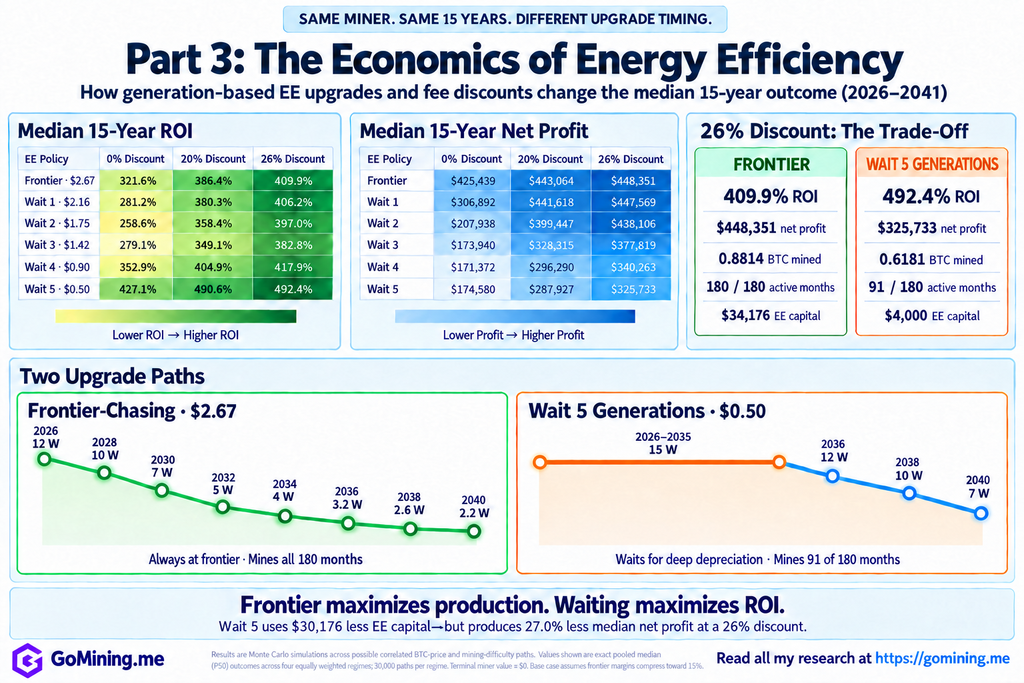
Median ROI
| Strategy | 0% discount | 20% discount | 26% discount |
|---|---|---|---|
| Frontier | 321.6% | 386.4% | 409.9% |
| Wait 1 | 281.2% | 380.3% | 406.2% |
| Wait 2 | 253.6% | 358.4% | 397.0% |
| Wait 3 | 279.1% | 349.1% | 382.8% |
| Wait 4 | 352.9% | 404.9% | 417.9% |
| Wait 5 | 427.1% | 490.6% | 492.4% |
Waiting five generations achieves the highest median ROI at every discount level.
This does not mean it creates the most wealth. It means it produces the greatest return relative to the total capital committed.
Median Net Profit
| Strategy | 0% discount | 20% discount | 26% discount |
|---|---|---|---|
| Frontier | $425,439 | $443,064 | $448,351 |
| Wait 1 | $306,892 | $441,618 | $447,569 |
| Wait 2 | $207,938 | $390,447 | $438,106 |
| Wait 3 | $173,940 | $328,315 | $377,819 |
| Wait 4 | $171,372 | $296,290 | $340,263 |
| Wait 5 | $174,580 | $287,927 | $325,733 |
Frontier-chasing produces the highest median net profit.
However, at the 26% discount, waiting one generation finishes only $782 behind the frontier strategy while spending $7,392 less on EE upgrades. That makes waiting one generation an especially strong compromise between production and capital discipline.
How Fee Discounts Affect the GoMining EE Upgrade Strategy
Discounts reduce both electricity and maintenance costs. That allows older, less-efficient miners to remain profitable for longer.
At the 26% discount, the median active periods are:
| Strategy | Active months |
|---|---|
| Frontier | 180 |
| Wait 1 | 180 |
| Wait 2 | 178 |
| Wait 3 | 152 |
| Wait 4 | 118 |
| Wait 5 | 91 |
The wait-five strategy does not mine continuously. It remains on older efficiency bands for much longer, so it pauses when mining revenue no longer covers operating costs and resumes only when an eligible upgrade restores profitability.
What This Means for GoMining Owners
There is no single best upgrade policy because ROI and absolute profit answer different questions.
Choose frontier efficiency if the objective is to:
- Mine the most Bitcoin
- Remain active for the longest period
- Maximize median net profit
Wait for cheaper efficiency if the objective is to:
- Limit additional capital commitments
- Increase return on total capital deployed
- Accept lower BTC production in exchange for a higher ROI
For investors seeking a balance, waiting one generation appears particularly competitive under the 26% discount. For investors focused purely on capital efficiency, waiting five generations produces the highest median ROI.
Final Takeaway
Energy efficiency has value, but its value depends on the price paid for it.
The simulation’s central finding is:
Frontier-chasing maximizes Bitcoin production and absolute profit. Waiting for older EE generations maximizes ROI by committing substantially less capital.
The right strategy therefore depends on whether the objective is to maximize the size of the outcome or the efficiency of the investment.
Disclaimer: This analysis is based on modeled future Bitcoin prices, mining difficulty, efficiency improvements, operating costs, and EE prices. The post-2032 efficiency frontier and future upgrade prices are assumptions rather than forecasts. Monte Carlo results illustrate a range of possible outcomes and do not predict any individual investor’s result. This article is for informational purposes only and is not financial advice.
Leave a Reply