GoMining Tokenomics: The Conclusion
GoMining tokenomics combine permanent token burns with long-term token locking. But supply is only part of the equation.
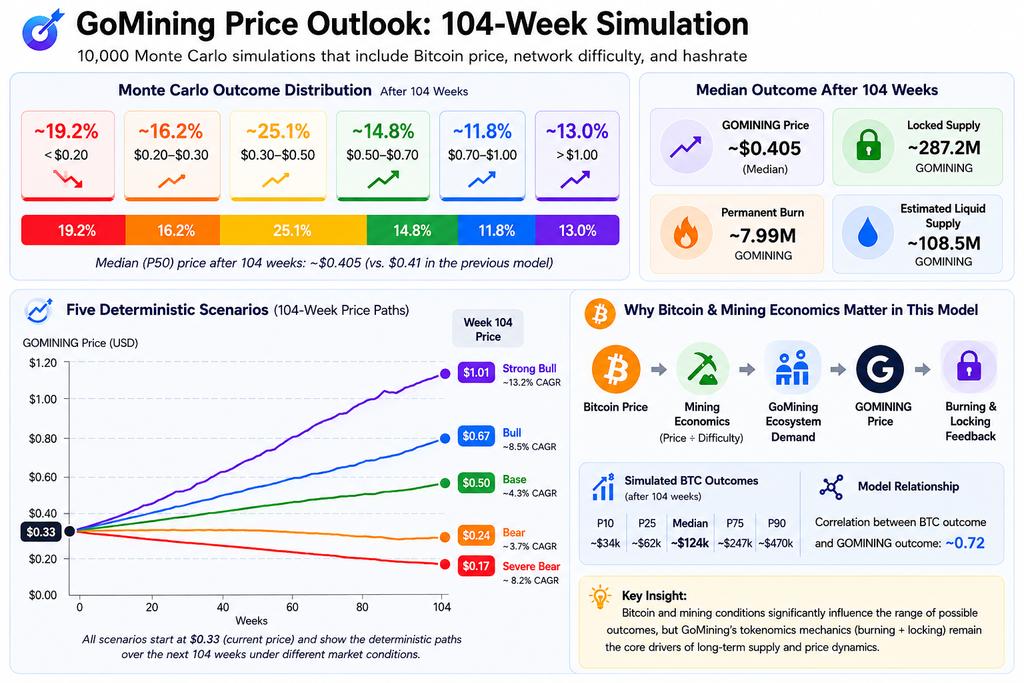
To explore what could happen over the next 104 weeks, I ran 10,000 simulations incorporating GOMINING’s tokenomics, Bitcoin market conditions, mining economics and changes in token demand.
Starting from $0.33, the median simulated GOMINING price after 104 weeks was approximately $0.405.
But there was a wide range of possible outcomes. Around 35% of simulations finished below $0.30, while roughly 13% finished above $1.00.
| Price after 104 weeks | Probability |
| Below $0.20 | ~19.2% |
| $0.20–$0.30 | ~16.2% |
| $0.30–$0.50 | ~25.1% |
| $0.50–$0.70 | ~14.8% |
| $0.70–$1.00 | ~11.8% |
| Above $1.00 | ~13.0% |
The important takeaway is not whether GOMINING reaches a particular price.
The simulation suggests that GoMining’s supply mechanics can strengthen the effect of growing demand. However, Bitcoin, mining economics and demand still have a much larger influence on the range of possible price outcomes.
GoMining’s tokenomics can amplify growing demand, but they cannot compensate for disappearing demand.
How I Computed It
For a deeper explanation of the mechanics behind the model, I previously broke down why GoMining’s tokenomics are designed around locking, utility and the burn-and-mint cycle.
The model is based on GoMining’s documented Burn & Mint and veGOMINING tokenomics mechanics, combined with the current locking and net-burn figures used in our analysis.
- Starting price: $0.33
- Circulating supply: 403.393M
- Locked supply: ~256M
- New locking: ~500k GOMINING/week
- Net permanent burn: ~80k GOMINING/week
- Simulation period: 104 weeks
1. How GoMining Tokenomics Change With Price
I do not assume 500k tokens will be locked and 80k burned every week indefinitely.
As GOMINING rises in price, fewer tokens are required for the same economic activity. The model therefore reduces locking and burning as price rises — and increases them when price falls.
2. Locked Tokens Eventually Expire
Existing locks expire. Holders can then unlock their GOMINING or lock it again. I’m doing this myself as part of my GoMining locking strategy, where I’m building a long-term locked position while earning weekly rewards.
New Locks → Expiries → Re-locking → Net Locked Supply
The model assumes re-locking tends to be lower in weak markets and higher in stronger markets.
3. I Simulated 10,000 Futures
Rather than choosing one price target, I simulated 10,000 different 104-week paths, varying market conditions, volatility, locking, burning, expiries and re-locking.
In the median simulation:
- Price: ~$0.41
- Permanently burned: ~7.9M GOMINING
- Locked supply: ~287M
- Estimated liquid supply: ~108M, versus ~147M today
That represents roughly a 26% reduction in estimated liquid supply.
The Bottom Line on GoMining Tokenomics
The burn alone isn’t the main story.
The more interesting combination is:
Permanent burn + high token locking + continued demand.
If demand weakens, GOMINING can still fall substantially.
If demand grows while liquid supply continues shrinking, however, the tokenomics could amplify the resulting price pressure.
Demand is the engine. Tokenomics are the accelerator.
Disclaimer: This is a model-based simulation, not a price prediction or financial advice. Results depend heavily on assumptions about future demand, token locking, expiries, re-locking and market conditions.
Leave a Reply